What the Jury Never Saw:
— The James Conway Story
A detailed examination of how Ronald Trent's fabricated testimony, Detective Zach Scott's misconduct, and prosecutorial suppression of evidence resulted in two wrongful death sentences against James Conway — a man who has maintained his innocence for 24 years.
James Conway has been on Ohio's death row since 2003, convicted in two separate Franklin County cases — the Dockside Dolls nightclub shooting of January 19, 2002, and the death of Andrew Dotson in October 2001. In both cases, the prosecution's star witness was the same man: jailhouse informant Ronald "Ronnie" Trent. In both, nearly all of the evidence was collected by the same person: Franklin County Sheriff's Detective Zach Scott. And in both, what the jury was shown bears almost no relationship to what the underlying evidence actually establishes.
Four findings drive that conclusion. First, Detective Scott has a documented federal-court ruling against him in another case for the exact conduct he is alleged to have engaged in here — coercing a witness into falsely incriminating a defendant. Second, Ronnie Trent was already documented, in a sworn affidavit signed by a former Franklin County prosecutor, as a man who fabricates confessions to escape his own charges — eighteen months before he ever took the stand against Conway. Third, in the Dockside case, the State withheld surveillance footage that directly contradicts its premeditation theory and called a detective to mislead the jury about what the footage shows. Fourth, in the Dotson case, the State's own medical examiner made three findings that cannot fit the prosecution's timeline of when and where Dotson died.
What follows is based on a 171-page document written by James Conway which meticulously documents the lies, the manipulated transcripts, the fabricated crime scene diagram, the suppressed surveillance footage, the coerced witnesses, and the perjury committed by both Trent and Detective Scott. The evidence does not merely cast doubt on Conway's guilt. It demonstrates, systematically, that the prosecution's case was built on fiction.
Ronald Trent: The Man Who Built This Case
Read the evidence. Draw your own conclusions.
(a) The Braun Affidavit — Ronald Trent Has Been Lying to Prosecutors Since at Least 1991
The single most significant piece of evidence in the Dockside pretrial hearing had nothing to do with the shooting itself. It concerned the character and credibility of Ronald Trent — the same man the State was presenting as a key witness in both of Conway's death penalty cases and in the capital case against Conway's codefendant Calvin "Jamie" Horton. The defense called Timothy F. Braun.
Braun was a Franklin County Assistant Prosecuting Attorney from August 3, 1987 through November 18, 1997 — a full decade. He was then serving as an Assistant Prosecuting Attorney in Lucas County. He drove from Toledo to Columbus specifically to testify.
During his time in the Franklin County Prosecutor's Office, Braun prosecuted a man named Terry Mayle — three separate times. Approximately 1991 or 1992, Braun received a contact through a social worker at Orient Prison (the facility where Trent was incarcerated). The message was from Ronald Trent. Trent claimed he had shot a man named Ray Seel, and that Terry Mayle — whose three trials Braun had prosecuted — was innocent and had not been present when the shooting occurred. Braun went to Orient Prison with a detective and recorded the conversations.
Braun's testimony about what he found: "The information I received from Mr. Trent did not match what I knew about the case, didn't match what other witnesses said, and at that point I did not believe what he was telling me." When asked directly whether he believed Trent was lying at the time, Braun answered: "Yes, I did."
Braun fulfilled his legal obligation by notifying Mayle's attorney, but the investigation produced nothing that justified overturning the conviction. Trent's claim that he was the actual shooter was disbelieved by the very prosecutor who knew the case best.
Roughly a decade later — approximately 2001 — Trent resurfaced. He filed a new affidavit in Judge Cain's court, once again claiming he had shot Ray Seel and that Mayle was innocent. In direct response, Braun signed a sworn counter-affidavit on July 10, 2001 (admitted as Defense Exhibit 6 in the Dockside hearing). That affidavit documents Braun's earlier investigation, his recorded interview of Trent, and his conclusion that Trent was not truthful. Under oath during the Dotson trial, Trent eventually admitted he had accepted a "couple thousand dollars" to sign the false affidavit. (Reference 6, 3117 TT p. 773.)
A former Franklin County APA put in writing, under oath, that Ronnie Trent lies about crimes to deceive prosecutors. The Braun affidavit (Defense Ex. 6, July 10, 2001) establishes:
1. In approximately 1991–1992, Trent approached the Franklin County Prosecutor's Office from inside Orient Prison claiming to have committed a crime for which another man had been convicted.
2. Braun investigated. He recorded the conversations. He compared Trent's account against his knowledge of the case and available witness testimony.
3. Trent's story did not match the evidence. Braun concluded Trent was lying.
4. Ten years later, Trent repeated the same claim — and this time the State of Ohio was simultaneously using him as a key witness in four criminal prosecutions, including two capital murder cases.
5. Trent admits taking a couple thousand dollars to sign the false affidavit for Mayle.
The pattern is clear: Trent has a documented history of approaching prosecutors with fabricated confessions to crimes he did not commit. Whether he does this to curry favor, to manipulate the justice system, or for some other motive, the record shows he has done it before — and a sitting APA documented it under oath before the Conway case ever began.
(b) Detective Zach Scott
Detective Zachary Scott of the Franklin County Sheriff's Office was the lead investigator in the Dotson case and acted as point man for Trent as Trent investigated the Dockside Dolls case. From the outset, Scott demonstrated a pattern of deciding who was guilty first — then building a case to fit that conclusion, regardless of where the evidence pointed. Scott would later run for Franklin County Sheriff and Mayor of Columbus. Understanding his personal political stake in high-profile convictions is essential to understanding why he was willing to overlook Trent's mounting lies, use an informant posing as a hitman to terrorize witnesses, and violate a judge's separation order during trial to coach a key witness.
In 1997, Kareem Jackson was arrested and charged with the execution of two witnesses during an armed robbery. Det. Scott was assigned to investigate the homicides. Jackson was eventually convicted based on statements by his then live-in girlfriend, Ivana King, given during an interview by Scott. The tape log slip for this interview began at 7:51 pm and ended at 7:53 pm. In the interview, King told Scott that upon returning home the day after the homicides, Jackson confessed to her that he had "done two people." This evidence was described by the federal appellate court as "quite incriminating."
It wasn't until nearly 20 years later, after Jackson had exhausted all his appeals and was set to be executed, that the circumstances behind King's statement came to light. It turns out that Scott had King in that interview room for over two hours prior to her making her two minute statement, a fact hidden from Jackson throughout his entire appellate process. During this two hour period Scott repeatedly told King to say Jackson confessed to having "done two people", along with other statements, and threatened that he would have her kids taken from her if she did not cooperate. Once Scott's coercion came to light, Jackson filed a last minute appeal with the federal district court and was given an evidentiary hearing which occurred in June 2023. King testified that Jackson never made any such statements and that she only said that he had because she was intimidated by police and afraid of losing her kids. The hearing was held before federal district court Judge Algenon Marbley who found King's testimony credible and found that "police were complicit in the manifestation of her lie." Police being Det. Scott. Judge Marbley found "…compelling evidence of a level of leverage, intimidation, and coercion designed to obtain, and succeeding in obtaining, from King a statement incriminating Jackson for the murders." Source: Judge Marbley's Decision.
(c) Detective Scott Meets with Trent
When Trent first met with Detective Scott in the Franklin County jail, he claimed Conway had confessed to the Dotson killing. What Scott failed to investigate — or chose to ignore — was that Trent was close friends with Mike Arthurs's uncle. Arthurs had confessed to killing Dotson to his entire family. It was common knowledge in their circle. Trent likely knew Arthurs killed Dotson before he ever met Conway, and simply repackaged that information as a "confession" from Conway.
"Conway never knew he was giving information to law enforcement."
Conway is portrayed as an unwitting subject who had no idea Trent was working with police.
"Conway actually instructed him to write the letter so that Trent could be placed in protective custody to kill a witness."
Now Conway is a sophisticated criminal mastermind who orchestrated the entire informant operation.
(d) Despite Lies, Detective Scott Decides to Use Trent
Before Trent ever testified, it was clear he was a habitual liar. He had fabricated confessions at least twice before — including for Terry Mayle — to get out of prior charges. Yet Scott proceeded, because Scott had already decided Conway was guilty, and Trent was his vehicle to a conviction.
(e) Trent Lies About Getting "Paid to Do a Job"
Conway has a "contract out" on McWhorter's life.219
Trent was supposed to "find someone" to kill McWhorter.220
Trent was to go into protective custody and kill McWhorter himself.221
In the only two recorded conversations between Trent and Conway about McWhorter, Conway says neither he nor his attorney is worried about McWhorter.223
(f) A Few Assorted Lies — Trent's April 10 Letter
(g) Scott's Flair for the Dramatic — The Transcript Manipulation
A recording exists of Trent and Calvin Horton discussing where to mail a confession video — to prosecutor Prichard, or to Ron O'Brien? In Trent's handwritten additions to the transcripts, this mailing discussion was transformed into a discussion of which prosecutor to kill.
Trent and Horton discussing where to MAIL a confession video — to Prichard or to O'Brien.
A logistical discussion about where to send exculpatory video evidence.
Trent and Horton discussing which PROSECUTOR TO KILL — Prichard or O'Brien.
Trent's handwritten "recollections" transformed a mundane mailing question into a murder conspiracy.
(h) Despite His Lies, Trent Gets a Sweetheart Deal
With all his documented lies on the record, prosecutors still reduced Trent's felony child molestation charges to misdemeanors — keeping him off the sex offender registry. The victim's mother testified she felt intimidated and that charges would be reduced whether she agreed or not. What she didn't know: prosecutors would also testify on Trent's behalf at his parole hearing, allowing him to walk free entirely. Within just over a year, Trent raped his girlfriend's daughter.
The Dockside Dolls Shooting
On January 19, 2002, James "Jim" Conway was at the Dockside Dolls nightclub in Columbus, Ohio. He had arrived before his brother Jeff, passed through a metal detector (meaning he was unarmed upon entry), and was receiving a lap dance when his brother arrived. Hours later in the parking lot at closing time, Jeff was stabbed in the abdomen by Mandel Williams. Rob Meyers, a friend of Conway's, retrieved a gun from the trunk of his car and as Williams was coming at Jeff again, Conway took the gun from Meyers and fired on Williams. Williams used bystander Jason Gervais as a human shield as shots were fired in rapid succession. Gervais was struck below the waist — shots only fatal because of the way Williams positioned him as a shield.
The prosecution charged premeditated murder. To make that charge stick, they needed three things: evidence that Jeff had called Jim to the bar, evidence that Jim had time and opportunity to form a plan before firing, and a statement showing Jim intended to kill. Each of those three things was either fabricated or conflicting evidence was suppressed.
(a) The Prosecution's Case — Three Arguments
The prosecution's theory of premeditated murder rested on three separate claims — each one presented to the jury as established fact, and each one contradicted by evidence the jury never saw.
James Conway arrived at 1:18 AM. Jeff Conway's car did not appear on the footage until 1:36 AM — eighteen minutes later. Jim was already inside, through the metal detector, getting a lap dance before Jeff reached the parking lot. A man cannot be "called to" a place he is already at. To suppress this footage, prosecutors called Detective Gravett to testify it showed nothing relevant. Gravett said only one individual — "Jimmy Turner" — could be identified. "Just the one individual, nobody else." Jennifer Conway — James's sister — recently went through the footage frame by frame and annotated each still, identifying every key individual by time and position. Her work tells a completely different story from Gravett's testimony. (See section b below.)
The actual crime scene photographs show Williams's car (CSQ-6099) nearly bumper-to-bumper with another vehicle, with shell casing placard #9 even with the front bumper of that car. On Detective Jackson's diagram, the car and the shell casing were moved approximately twenty feet closer to where Williams and Gervais were found — creating the appearance of a point-blank execution walk that the photographs prove never happened. (See section d below.)
When Trent first gave a statement to police on May 26, 2002, Conway allegedly said: "Fuck it, I got a 45, I'm just going to keep on shooting." No reference to Gervais. No intent to shoot through anyone. Trent never spoke to Conway again after that date. By the time he testified at trial in 2003, the statement had become: "Fuck it, I got a .45 that will go through Gervais and kill Williams." That added phrase — invented after all contact had ended — is the only evidence that Conway intended harm to Gervais. It is the entire basis for the death penalty. (See section g below.)
(b) Did Jeff Call His Brother for Help? — The Surveillance Evidence
Two facts. Both documented. Both verifiable.
Detective James Gravett testified under oath that after the surveillance tape was professionally slowed and analyzed, only one person could be identified — "just the one individual, nobody else."
The footage shows James Conway arriving at 1:18 AM — eighteen minutes before his brother Jeff. He went directly to a private dance. He was at the door before Jeff's car appeared in the parking lot.
The prosecution's entire premeditation theory requires the opposite to be true. The jury never saw the footage and was misled by Gravett's testimony.
"Jeff called James Conway to the bar because Jeff was having a problem. James arrived with Meyers, Horton, and the .45 pistol."200
This narrative — argued to the jury repeatedly — formed the basis of premeditation.
James Conway arrives at 1:18 AM and goes directly to a private dance. Jeff Conway's car doesn't appear until 1:36 AM — 18 minutes later. Williams doesn't arrive until 2:44 AM, with a carload of armed men, 15 minutes before closing.201
James arrived BEFORE Jeff. He cannot have been "called" there by his brother.
(c) The .45 Gun Case
Prosecutors submitted a photo of a Colt .45 gun case from Conway's bedroom as evidence that the gun used in the Dockside shooting belonged to him. The photo the State used at trial was at an angle that obscured the identifying information on the case. The gun case shown was for a compact Colt .45 with a matte blue finish, serial number CP29695. Multiple witnesses described the Dockside gun as a large semi-automatic pistol.203
Gun CP29695 was in the prosecutors' own possession at the time of trial.205 They have refused to hand over the ballistics report for it. The actual Dockside gun was never recovered. If CP29695 had matched, they would have used it against Conway.
(d) The Fabricated Parking Lot Diagram
Prosecutors' premeditation theory required Conway to have walked a long distance up to Williams and Gervais before firing at point blank range. Detective Kevin Jackson created a parking lot diagram supposedly based on measurements from the crime scene. The diagram directly contradicts the actual crime scene photographs.
On the diagram, Williams's car (CSQ-6099) and the final shell casing (placard #9) are placed next to placards #10 and #11 — where Williams and Gervais were found — supporting a point-blank range narrative.
In the actual crime scene photographs, CSQ-6099 is nearly bumper-to-bumper with another car (Cruiser R-26), and placard #9 is even with the front bumper of that car — significantly further from where Williams and Gervais were found.208,209 The prosecution simply moved the car and the shell casing approximately twenty feet in their diagram.
Detective Jackson refused to admit on cross-examination that there was even a problem with his diagram.211
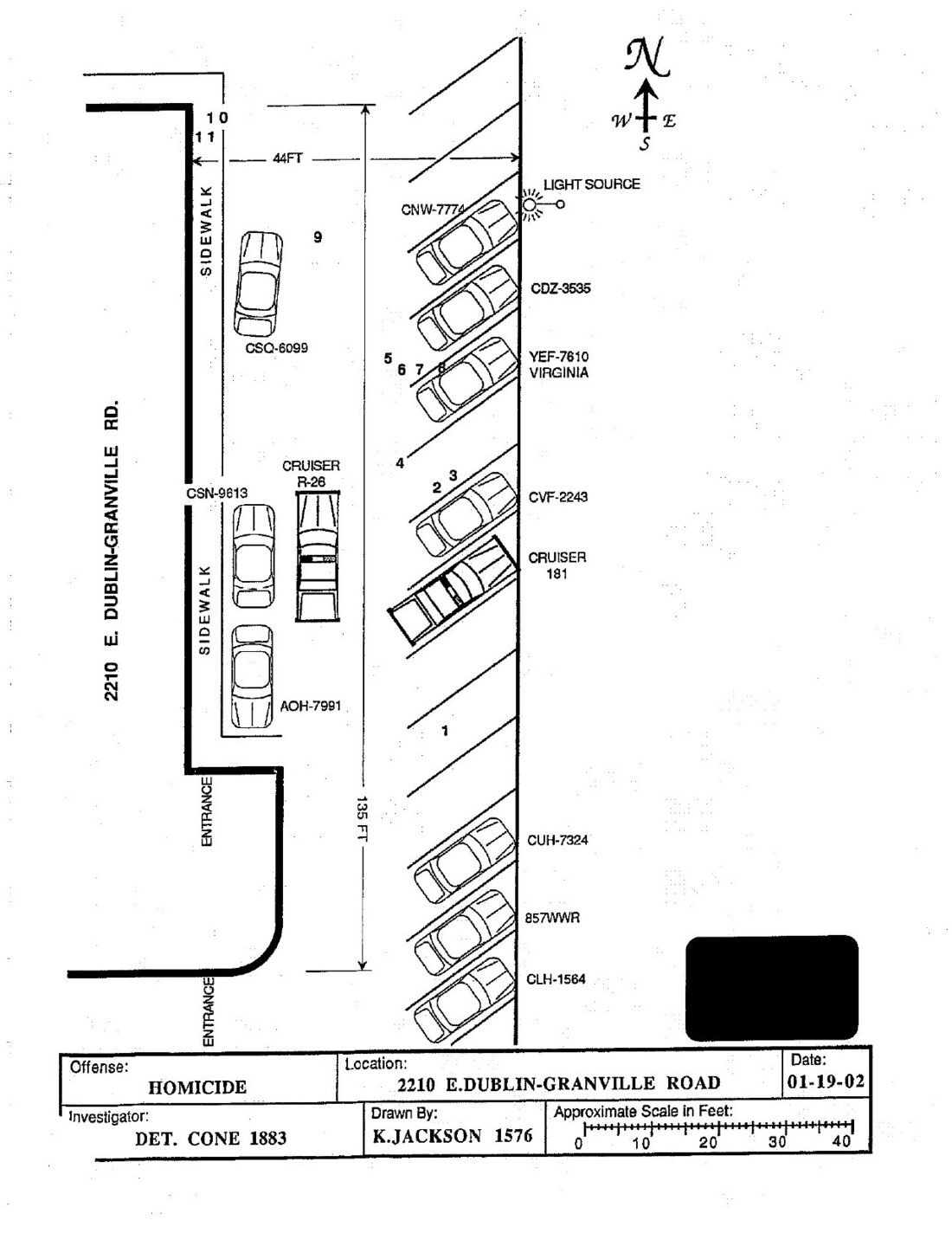
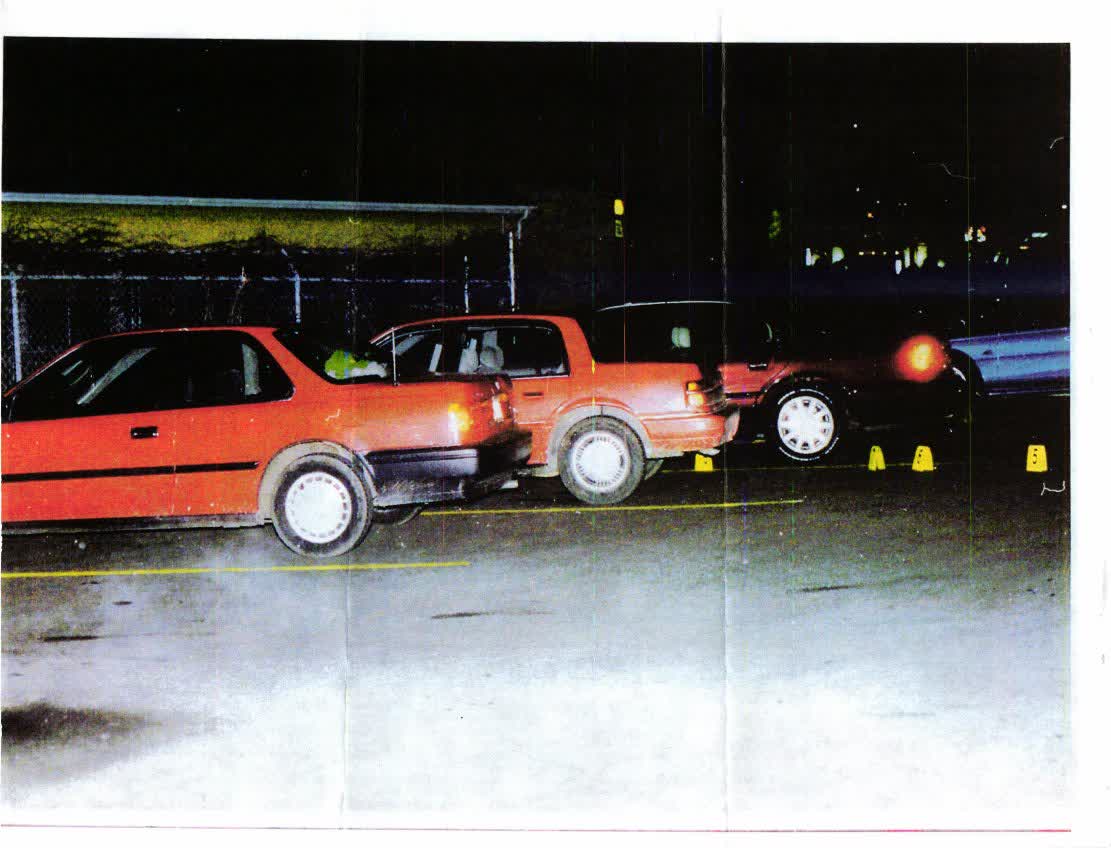
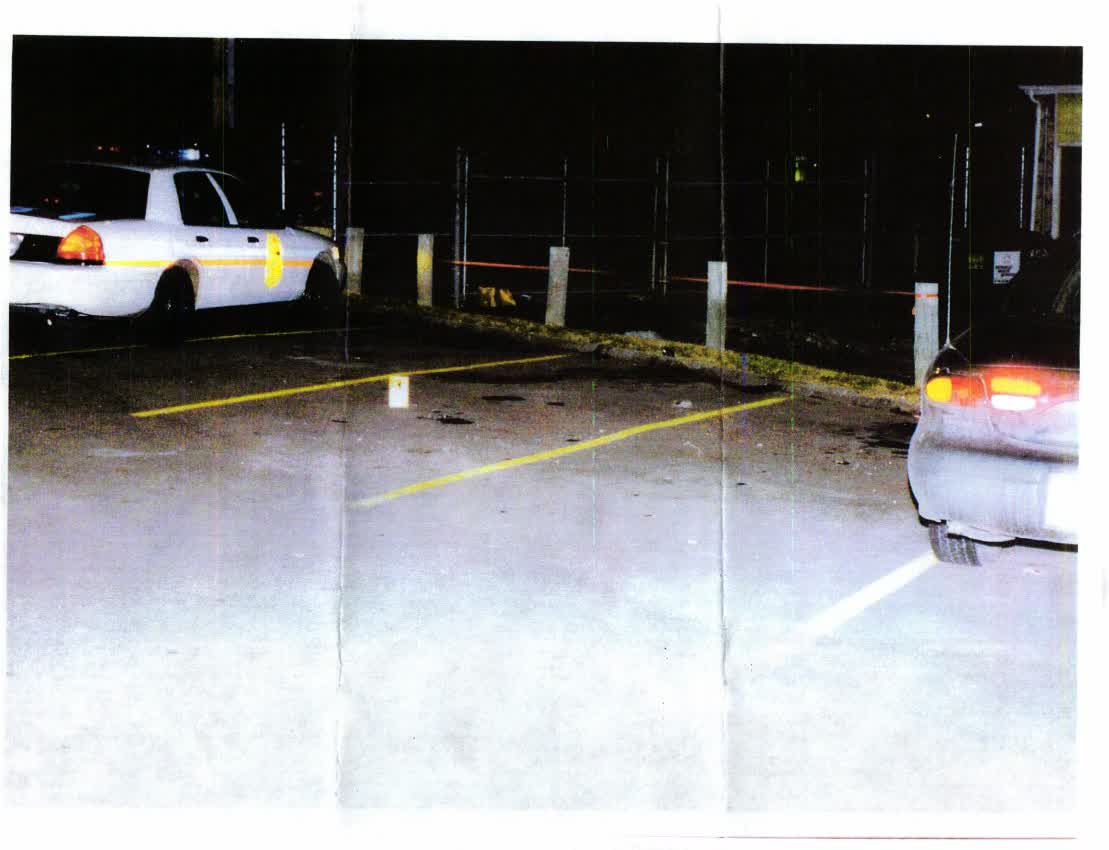
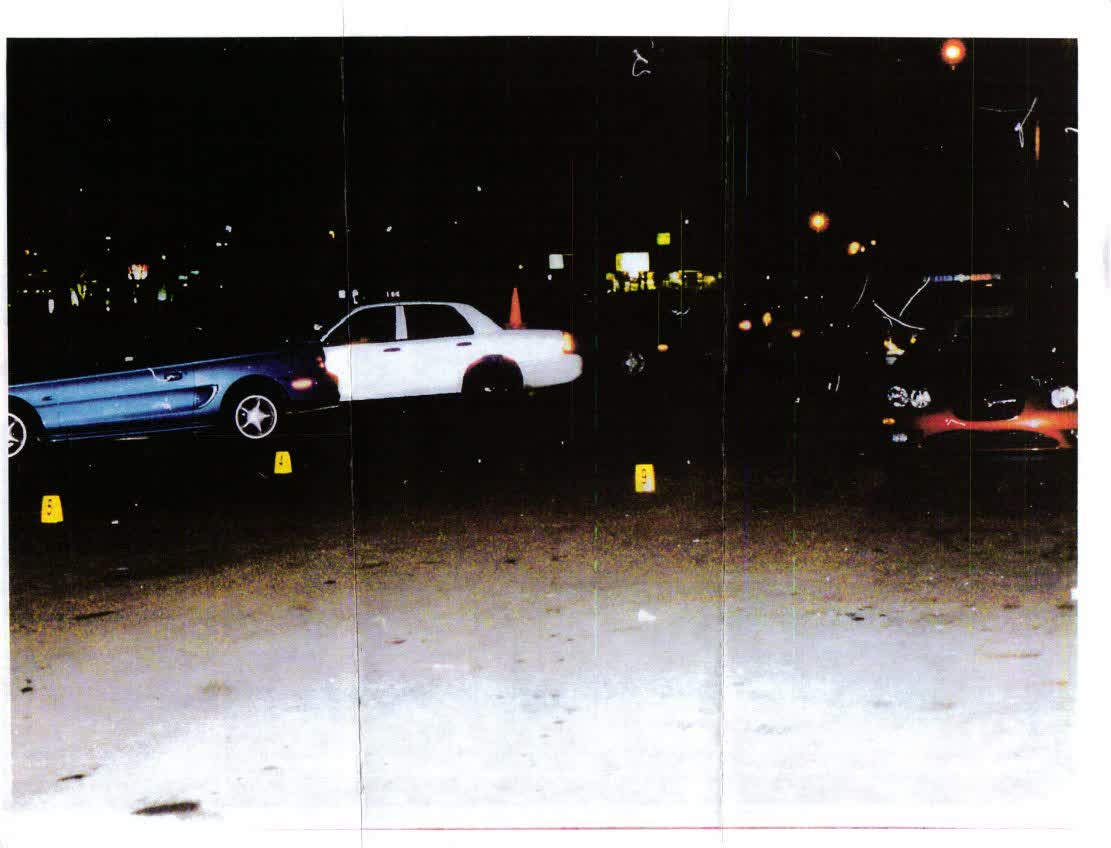
What the comparison shows. On Jackson's diagram, Williams's car (CSQ-6099) sits in a parking space separated from Cruiser R-26 by roughly twenty feet of empty pavement, with the final spent casing (placard #9) drawn next to CSQ-6099 — close to placards #10 and #11, where Williams and Gervais were found. The photographs show a different reality: the cars are nearly bumper-to-bumper, and placards #4, #5, and #9 sit in positions inconsistent with where Jackson's diagram places them relative to the vehicles.
Why the difference matters. The State's premeditation theory required Conway to have walked a long, deliberate distance from where he retrieved the gun (placard #1) up to point-blank range of Williams and Gervais. That geometry depends on the positions depicted on the diagram. Restore the cars and placards to where the photographs show them, and the walk shortens — the "time enough to form the plan to kill" argument loses its physical basis.
The fabricated diagram also connected to the surveillance footage problem. The prosecution's "walked toward the victims" theory assumed Jim arrived at Dockside knowing a fight was coming — that he and Jeff had coordinated. The surveillance footage, documented in section (b) above, destroys that assumption entirely. The diagram and the suppressed footage were two tools serving the same false theory.
(e) Expert Reconstruction — Excluded from Trial
Conway's defense hired a professional accident reconstructionist who produced a computerized rendering of bullet trajectories using medical reports, autopsy data, and scene measurements. The reconstruction concluded that all shots were fired in rapid succession as Williams was running toward the shooter — not fleeing — and that the shot that killed Gervais struck him below the waist, only fatal because of the way Williams used him as a shield.213
(f) Ronnie Trent's Testimony at the Dockside Trial
Conway came to Trent with a plan to have someone falsely confess to the Dockside shooting.
Conway is portrayed as the architect of this scheme.
Trent tells Horton he has a "beautiful plan" — give him details of Dotson's death so he can make a video of someone confessing, "just like he did with Dockside."216,217
Trent invents this plan live on tape — then under oath says it wasn't his idea.218
(g) The Staged Confession and the Alleged Hit on Brian McWhorter
As additional evidence of guilt, the prosecution planned to offer under Ohio Rule of Evidence 404(B) — "other acts" evidence admitted to show consciousness of guilt. What emerged from those arguments was a window into the extraordinary scope of the State's reliance on Trent and the extent to which law enforcement participated in creating the very evidence it sought to admit.
The staged confession. Defense attorney Rigg revealed that Trent was expected to testify that while he and Conway were held together in the Franklin County jail, Conway asked him to arrange the following: (1) find someone who physically resembled Conway; (2) have that person record a videotaped statement saying they had committed the Dockside shooting, not Mr. Conway; and (3) after the tape was made, have that person killed so there would be no living witness to the scheme.
The hit on Brian McWhorter. Separately, the prosecution disclosed it intended to introduce evidence that Conway "hired Ronald Trent to kill Brian McWhorter who's a key witness to the Dockside Doll murder." Conway was separately indicted on a conspiracy to commit murder charge related to McWhorter, but those charges were ultimately dismissed. This allegation — like the staged confession — rests entirely on the word of Ronnie Trent, the same man a Franklin County prosecutor documented as a liar in a sworn affidavit signed eighteen months before this hearing.
The Court in the Dockside case ruled both items admissible under 404(B) as evidence of the defendant's "consciousness of guilt" and "preparation." The jury would hear Trent's account of a murder-for-hire plot and a scheme to create a video confession that was supposed to exonerate Conway.
The Circulatory Problem. The entire structure of the Dockside prosecution rested on Ronnie Trent — a man whom a sitting prosecutor called a liar under oath. The state used Trent to build evidence, Trent to carry evidence, and Trent's own actions (orchestrating the tape and the murder-for-hire plot) as the evidence of guilt. When the source and the instrument of collection are the same discredited informant, the result is not corroboration — it is circularity.
(h) The Statement That Gave Conway the Death Penalty
"Fuck it, I got a 45, I'm just going to keep on shooting."226
Trent never spoke with Conway after May 26, 2002.
"Fuck it, I got a .45 that will go through Gervais and kill Williams."225
After losing contact with Conway, Trent added the detail about intentionally shooting through Gervais — then attributed it to Conway.
(i) All Evidence Supports Conway Was Defending His Brother
Williams arrived armed: fully loaded semi-automatic handgun and a "razor with a black handle"235 — brought to a bar at closing time.
Williams blocked the exit: parked between the building and Jeff's car in the rear lot, knowing Jeff would have to pass him.
Williams shot in left shoulder:262 physically impossible if running north (away from shooter), confirming he was running toward Conway.
Williams was the aggressor: responsible for starting and escalating with a deadly weapon; cannot claim self-defense.249
Williams never charged: despite stabbing Jeff Conway with a razor, arriving armed with a loaded semi-automatic, blocking the exit, and being the sole aggressor whose attack on Jeff directly triggered the entire chain of events that ended in Gervais's death — Mandel Williams faced zero charges. The jury was instructed not to consider his criminal liability.
Expert reconstruction: shots fired in rapid succession as Williams charged toward shooter — consistent with defense, not execution.
(j) Jim Conway's Own Testimony: Low Aim, Tunnel Vision, No Intent to Kill
At trial, James Conway took the stand and testified in detail about what he saw, what he intended, and what he did. His account was internally consistent, corroborated by the physical evidence, and never successfully impeached on its core facts. The prosecution's closing argument acknowledged the defense-of-another claim was legally available — they simply argued the jury should reject it.
Jim testified that Rob Meyers retrieved the gun from the trunk of Calvin Horton's car only after seeing Jeff stabbed. When Williams emerged from behind the corner of the bar, between Jeff and where Jeff had parked his car, Jim's focus was on the lower body — he aimed at Mandel Williams's thighs and hips, intending to stop the threat without killing anyone. He testified that he experienced tunnel vision, common in extreme stress situations: he could not see Jason Gervais or any of the bouncers — only the target zone below Williams's waist. Everything happened in less than a second. He confirmed twice during his testimony — both on direct examination and under cross — that he did not know Jason Gervais was there.
His clearest statement of intent, on the record under oath: "I never had any intention of having anything done to any of them." He denied aiming to kill. He denied telling Trent anything about his purpose at the bar. He stated plainly that Ronnie Trent came up with the entire CI scheme on his own: "Ronnie Trent came up with that."
On why he retrieved the gun: Jeff had just been stabbed — the knife was out, Williams was moving — Jim could see no other option to stop the attack on his brother.
On aim: "I was aiming at his thighs and hips." Eight shots, fired in rapid succession, all intended to neutralize, not execute. He aimed low deliberately to avoid killing.
On Jason Gervais: "I never saw Jason Gervais." Confirmed on cross as well — tunnel vision on the lower body of the threat. Gervais was invisible to him.
On intent: "I never had any intention of having anything done to any of them."
On Trent's CI scheme: "Ronnie Trent came up with that." Jim's testimony — Trent invented the false-confession plan. Jim was not the architect; he was an obstacle Trent worked around.
On the gun: Jim snatched the gun from Rob Meyers's hand — it was Meyers's weapon, not Jim's. He had passed through a metal detector upon entry, confirming he was unarmed at arrival.
On the CI tapes: All CI tapes and transcripts were excluded from jury deliberation. The jury deliberated without the recordings — without the recordings that showed Trent orchestrating his own scheme, threatening the lives of witnesses, and told numerous lies to detectives.
"His brother got stabbed, and no one's saying he didn't."
The prosecution acknowledged Jeff Conway was stabbed. This is the entire factual basis for the defense-of-another claim. The State's argument was not that the stabbing didn't happen — it was that time had elapsed and the danger was over when Jim fired.
"I made a slashing motion and cut Jeff." Williams admitted on the stand that he had a knife and that he had cut Jeff Conway with a slashing motion.
The stabber identified himself. By Williams's own testimony, he was the aggressor with a blade.
(k) Two Key Witnesses the Jury Never Heard — Ineffective Assistance of Counsel
Two witnesses whose testimony could have materially altered the jury's assessment of the physical evidence were never heard from. Each omission may constitute a separate ground for ineffective assistance of counsel.
Carlton Hilson — Defense Firearms Expert. Hilson was qualified as an expert by the Court and permitted to testify over objection by the State. Hilson would have testified as to the characteristics of a Colt .45 pistol. Specifically, he would have explained to the jury that because of the design of the pistol it can be repeatedly fired in rapid succession without specifically intending to do so. Essentially, the gun cocks itself after each shot, and has a light and short trigger pull so that multiple shots can be fired by accident without specific intent. Hilson would have also testified to the fact that because of the large size of the bullet along with its relatively slow muzzle velocity, it would be far less likely to go through one person and hit another. Both of these claims were critical to contradicting the prosecution's theories of premeditation and specific intent.
Jamie Cope — Expert Accident Reconstructionist. Cope was disclosed as an expert witness, but was not allowed to testify. He would have confirmed the upward trajectories were consistent with low-angle shots. However, the reconstruction he had prepared — Defense Exhibit 38, the computer simulation — was excluded because the defense missed the notice deadline. The jury never saw the dynamic reconstruction showing Williams's movement. Cope could not offer his expert opinion which directly contradicted the prosecution's theory of the case. This is direct prejudice flowing from counsel's procedural error.
Together, these failures — a permitted expert never called, and a reconstruction excluded for a missed deadline — denied the jury evidence that could have corroborated Jim Conway's account of how and why he fired.
(l) The Consciousness of Guilt Instruction — Trent's Scheme Weaponized Against Jim
The jury instruction that may have done more damage than any other was one Jim Conway had no direct way to answer: the consciousness of guilt instruction. Over defense objection, the court instructed the jury as follows:
"Evidence has been introduced that the Defendant fled the scene of the crime, attempted to have evidence falsified by having a third party create a video confession, and also that the Defendant attempted to have witnesses eliminated or intimidated. An attempt by the Defendant to flee, to falsify evidence or to eliminate or intimidate witnesses may be considered by you in determining the Defendant's consciousness of guilt."
The circularity is devastating. James Conway's entire defense was that the video confession scheme was Trent's fabrication, not his plan. The recordings prove Trent invented the plan ("just like he did with Dockside"), that Conway did not want Trent to do this, and that Trent repeatedly ordered Conway to stop obstructing his own scheme. Yet the jury was instructed — based entirely on Trent's testimony — that they could treat this scheme as evidence that Conway knew he was guilty.
Similarly, the "witness elimination" language refers to the alleged McWhorter murder contract. The jury was told they could treat Trent's claim that Conway wanted McWhorter killed as evidence Conway knew he was guilty — despite the fact that even the prosecution's own witnesses eventually conceded Conway did not want McWhorter killed.
The consciousness of guilt instruction transformed Trent's fabricated scheme into an independent weight crushing Conway's credibility — the instruction told jurors that the very evidence Conway said was fabricated was proof that he knew he had done something wrong. The jury had no way to use this instruction without accepting Trent's account as true.
Separately, the jury was instructed on Troy Ankrum's changed testimony. Ankrum had originally testified that Mandel Williams used Jason Gervais as a human shield — direct corroboration of the defense theory. After a lunch break during trial, Ankrum changed his story. The defense moved to use this change to impeach him; the court allowed it. But the change itself was on the record before the jury.
The jury was also given a curative instruction regarding Mandel Williams — instructed expressly that they could not consider Mandel Williams's criminal liability (whether he was charged or should be charged) in determining Conway's guilt. This instruction effectively told the jury to evaluate Jim's defensive response in isolation from the question of whether the person he was responding to had committed a crime.
And no instruction was given on involuntary manslaughter. The court denied both voluntary and involuntary manslaughter as lesser included offenses. The jury could only choose between aggravated murder, murder, or acquittal — with no middle ground for a finding that Jim acted recklessly or without premeditation toward Jason Gervais. The Wanda Free negligence instruction, applied to Jason's death, had the same practical effect as an involuntary manslaughter instruction for the Jason count — but framed as a reason to deny the defense rather than as a lesser verdict option.
The Dotson Case
Andrew Dotson was found dead on Galloway Road, Columbus, Ohio, on October 10, 2001. Detective Scott got a break when Trent claimed Conway had confessed to killing Dotson. In fact, Dotson either died from a drug interaction, or was killed by Mike Arthurs who bragged about it to anyone who would listen until his own death from a drug overdose in 2016.
Arthurs, Nightingale, and Dotson were all running together stealing and fencing ATVs across Columbus and into Chillicothe. When police began looking for Dotson in connection with the Jesse James shooting, Arthurs became angry and worried — Dotson could expose all of them for the multiple burglaries and thefts they had committed together. Nightingale confirms this explicitly: Arthurs "wanted me to give him a spot to do it and that's what I was doing." This is the actual motive for Dotson's death. It had nothing to do with James Conway.
Of course, Arthurs claimed Conway had pulled him and Nightingale aside at a party at the Hampton Inn in Chillicothe and asked them to kill Dotson. Arthurs says he agreed, and he and Nightingale took Dotson to West Virginia to kill him, but changed their minds. They then brought Dotson back to Columbus and took him to a cornfield on Galloway Road where, for some reason, Arthurs claims he pretended to choke Dotson by putting him in a headlock and then standing on Dotson's throat. It was only after all this that Arthurs claimed Conway stepped in and stabbed Dotson to death. In exchange for this testimony, Arthurs received a deal in which he actually didn't have to serve a single day in prison for Dotson's death.
(a) More Lies from Trent
Conway confessed that Nightingale and Arthurs were to drug Dotson and leave him in West Virginia. Conway stood on Dotson's neck until he was dead.270
Trent clearly states the only information he received in jail with Conway was that Arthurs killed Dotson by standing on his neck.271
(b) Det. Scott Uses Trent to Coerce Witnesses — Then Lies About It Under Oath
Scott directed Trent to pose as a hitman while making recorded conversations with Conway, Horton, and Nightingale. Trent threatened to kill Horton if Nightingale "turned snitch." He told Conway to cut his losses. He said he had killed before and would again. He carried pictures of people he had "allegedly killed." He threatened to kill Horton if Horton didn't tell him the details of Dotson's death.305 Horton changed his phone number to avoid Trent; Trent tracked it down through other contacts.
Immediately after leaving Horton, into the wire: "Dude, he is so fuckin scared, it is unbelievable. It's on tape."295
Trent reporting to Scott that his intimidation of Horton is working.
Q: "Did you ever threaten [Horton]?" Trent: "No."
Q: "Did you ever tell him you were going to kill him?" Trent: "No."314
Scott was asked the same questions and responded "No" to both.315
(c) The Dotson Family — Contradicted by Their Own Prior Statements
Dotson's girlfriend Roberta Hannah testified Conway once confronted Dotson by walking up to his car window and threatening him as she sat in the passenger seat. In her initial interview after Dotson's death, she stated she had never met Conway and didn't know what he looked like because she'd only seen him driving by in a car.327
Dotson's mother Lora Eberhard testified Horton was with Dotson the last time she saw him. Her initial statement described the second man as "short, stocky, with blonde hair" — matching Arthurs exactly, not Horton (6'4", dark brown hair).331,332 Prosecutors withheld her statement until moments before she took the stand, preventing Horton's attorneys from using it on cross-examination. Eberhard still denied making the statement.
(d) Jesse James Shooting as Motive — Built on Nothing
Scott decided, without any evidence, that Conway shot Jesse James and that Conway wanted Dotson killed to prevent him from telling police. Every piece of evidence pointed to Dotson as the James shooter — Dotson confessed to his girlfriend immediately afterward and fled Columbus.336,337 Jesse James never identified Conway. Nightingale told Scott directly that Dotson was killed because Arthurs "wanted to do it so he would be known as a killer."347 Scott ignored this and allowed Trent to testify to the James shooting motive — a claim Horton contradicted in the recordings themselves.345
There is a further problem with this motive narrative: Arthurs didn't know about the Jesse James shooting when he first spoke with police. He learned about it from investigators. A man claiming Conway ordered him to kill Dotson in retaliation for the Jesse James shooting — who had no knowledge of that shooting until police briefed him — cannot have received those instructions from Conway. The entire revenge motive was constructed after the fact, built from information fed to Arthurs by the same detective who needed the conviction.
(e) Hampton Inn — Witness Tampering During Trial
Mike Arthurs testified at Horton's trial that Conway instructed him to kill Dotson in the bathroom of Arthurs's hotel room at the Hampton Inn in Chillicothe. Arthurs testified that he and Nightingale took Dotson to West Virginia the following morning and killed him later that same night. Prosecutors provided a receipt intended to corroborate Arthurs that said he rented a hotel room at the Hampton Inn in Chillicothe on September 11, and checked out the morning of September 15, the day after the Jesse James shooting.
When Dotson's girlfriend testified in Conway's trial that she last spoke with Dotson on September 16 — proving he was alive the day after Arthurs's hotel checkout — Arthurs's prosecution timeline collapsed. Prosecutors needed Arthurs to change his testimony. The judge had ordered no contact between witnesses. Scott waited for a court recess, slipped through a door from the courtroom directly into the jail (bypassing the visitor log), and met privately with Arthurs for nearly an hour. Conway's attorney witnessed Scott entering and notified the judge.
When Arthurs took the stand immediately after this recess, he suddenly claimed he had used a fake name to rent the hotel room — a claim never made before in any prior statement or in the Horton trial.373 The Hampton Inn's general manager testified that identification is required and that someone checked in under Arthurs's real name and Chillicothe address.375,376
(f) Arthurs — Documented Violent Outbursts
Nightingale's account: Arthurs had his foot on Dotson's neck pressing down so hard that Nightingale's Jeep was lifting off the ground — for five to ten minutes, until the neck was "flat" and the "imprint of a shoe" was visible on it.406,407 Nightingale says Arthurs then tried to snap Dotson's neck, and bones could be heard breaking.412 Arthurs "went berserk" and killed Dotson "without nobody saying anything to him."415
Arthurs received no additional prison time for Dotson's death. He had won the Tough Man Contest in Chillicothe and was later convicted of assaulting a police officer. The jury was asked to believe this man killed Dotson simply because James Conway asked him to, and felt "afraid" of Conway.
Nightingale was explicit even under extreme pressure from Scott to change his story. During his initial interrogation, Nightingale was adamant: "[Arthurs and I] never talked to [Conway]... we just never fucking talked... [Conway] never fucking said nothing to me at that time."393 It was at that moment that Scott told Nightingale that Conway was the one responsible — and that if Nightingale didn't adopt that version, he would be blamed for Dotson's death himself.394 Even under that direct threat, Nightingale still maintained: "I know Mike [Arthurs] did it. It was Mike. Nobody helped Mike."395
Arthurs himself admitted he came up with the idea on his own.405 He never alleged Conway threatened or intimidated him — only that Conway "asked" and he agreed. A man who won a combat fighting contest, who later assaulted an armed police officer, who was physically the dominant presence in every situation described, and who was in possession of a firearm — was not driven to murder by fear of James Conway.
(g) The Autopsy Contradicts the Prosecution's Timeline
The prosecution's theory required Dotson to have been heavily drugged on the trip from West Virginia — explaining why he didn't resist Arthurs. The state medical examiner, Dr. Patrick Fardal, found only therapeutic levels of Valium in Dotson's system with no metabolite (nordiazepam).427,428,429 This means Dotson ingested Valium within 45 minutes of death — not hours earlier in West Virginia, which is a four-hour drive from Columbus.430 The prosecution's own medical evidence contradicts their timeline of events.
(h) Trent's Own Recordings Confirm He Knew Conway Was Innocent
In the very recordings Trent was making for Detective Scott, Trent repeatedly acknowledges it was Mike Arthurs — not James Conway — who killed Andrew Dotson. On May 17, 2002, Trent asks Calvin Horton about getting "whoever did Andrew" to confess. Both men understand without clarification that this means Arthurs. Horton says "that's what happened." Trent then describes Arthurs standing on Dotson's neck until he died — the identical method Trent later attributed to Conway in his trial testimony.271
In another recording, Trent and Conway openly discuss Nightingale. Conway says Nightingale "don't really know nothing." Trent asks what he knows, and Conway replies he doesn't know. Between the two of them, it is understood that Conway played no part in Dotson's death and that Nightingale had no incriminating knowledge of Conway.304
Nightingale had already told Detective Scott directly: Arthurs "wanted to do it so he would be known as a killer." Arthurs bragged to Jason Woodruff, a friend of Nightingale's in Chillicothe, and Woodruff went to police.281 Arthurs confessed to his entire family. Trent — close friends with Arthurs's uncle — had almost certainly heard this before he ever met Conway in jail, and simply repackaged it as a Conway confession.
"What do you think about whoever did Andrew get him to confess as insurance you know what I'm saying can't hurt so"
Trent says "whoever did Andrew" — if Conway had confessed to him, he would have said Conway. Horton responds: "That's what happened."271
Conway confessed that he himself stood on Dotson's neck until he died and directed Nightingale and Arthurs to drug Dotson beforehand.270
(i) Conway Actively Worked Against Trent — The Opposite of a Co-Conspirator
The prosecution portrayed Conway as the mastermind who directed Trent's entire informant operation. The recordings prove the opposite. Trent is furious at Conway throughout May 2002 because Conway is working against him at every turn. Conway told Nightingale not to speak with Trent. He gave Nightingale instructions that contradicted Trent's. He told people Trent was making him suspicious. On tape, Trent repeatedly complains that Conway is "making my job a hundred times harder than it has to be."297
On May 25, 2002, Trent tells Conway for the first time that he plans to make a video of someone confessing to killing Dotson. The recording captures Conway's clear response: he does not want Trent to do this. Trent persists, instructing Conway to stay out of it and stop countermanding his orders. Trent is so agitated he tells Conway: "you need to let these guys know that I'm not no mother fucking cop and I'm not no mother fucking idiot, I know what the fuck I'm doing" — telling the supposed mastermind to stop obstructing his own operation.297
A criminal mastermind running a scheme does not need to be repeatedly ordered by his informant to get out of the way. Trent's own words document that he was running his own scheme and that Conway was actively interfering with it.
"Dude, you're fucking me up here, Jay, because dog, I got something I'm trying to do here man... you're giving other people instructions that's going against what the fuck I'm trying to do and you're making my job a hundred times harder than it has to be... no more change of plan, no more change of orders, no more change of instructions."
[Trent furious at Conway for repeatedly instructing Horton and Nightingale to ignore him. The supposed mastermind is so obstructive that Trent demands he stop interfering with the operation Trent is supposedly running on Conway's behalf.]
(j) How Horton Was Terrorized Into Giving Statements
Calvin Horton's statements — used against both himself and Conway — were given under the explicit belief that if he didn't cooperate, he would be murdered. Within days of Trent meeting Horton, Trent showed Horton a photograph of the dead body of someone he supposedly killed. Horton was visibly shaken. He changed his phone number to avoid Trent. When Trent tracked him down through Conway's girlfriend Britnee Stollings, Horton called from a payphone, refusing to give his new number.322
When Horton finally agreed to travel to Chillicothe with Trent, Conway himself confirmed the reason for his prior reluctance on tape: "Yeah, that's what he's afraid of" — Horton was afraid Trent wouldn't let him come back alive.307 Horton later told Trent directly: "whenever he showed me that shit I was like damn dog, I mean I freaked, for real" — acknowledging the dead body photo as the turning point.309
After hanging up with Horton on May 22, 2002, Trent spoke directly into the wire — reporting to Scott who was listening — and said: "Dude, he is so fuckin scared, it is unbelievable. It's on tape."316 This was Trent confirming his intimidation was working. Yet Trent testified under oath he had never threatened Horton. Scott testified he never recalled Horton being afraid. Both men committed perjury to prevent Horton's coerced statements from being suppressed.314,315
CI [Trent]: "Right, What, he's [Horton] afraid I wouldn't let him come back?"
CONWAY: "Yeah, that's what he's afraid of."307
Conway, on a wire recording, confirms Horton was afraid Trent would kill him. Scott was listening in real time through this wire.
Q: "Did you ever threaten [Horton]?" Trent: "No." Q: "Did you ever tell him you were going to kill him?" Trent: "No." Scott (same questions): Same answers.314,315
Scott answered "I don't recall him ever being afraid" — despite having heard every conversation through the wire, including the exchange above.
(k) Trent's Own Written Statement Names Nightingale and Arthurs — Not Conway
In Trent's handwritten statement dated May 24, 2002 — written the day before his final recorded conversations with Conway — Trent wrote in his own hand: "Shawn told me that him & Mike picked Andrew up around 12pm and fed him 11 Zanaks, 3 Somas, and some red heart pills..."454 Shawn is Nightingale. Mike is Arthurs.
The Tapes Don't Lie — Official Transcripts vs. Actual Recordings
Over 30 CDs of covert recordings were made during Trent's informant operation. The recordings were transcribed by the prosecution — and Trent was given access to those transcripts and allowed to add his own handwritten "recollections." The result was a set of official transcripts that differ materially from the actual audio recordings: words omitted, words added, and in the most consequential cases, statements changed in meaning. The pattern is consistent throughout — the official transcripts omit exculpatory context, strip statements showing Conway was not directing Arthurs's actions, and incorporate Trent's handwritten additions that transformed logistical discussions into murder conspiracies. A complete systematic review of the specific manipulations — instance by instance, with full exhibit numbers, CD numbers, tape numbers, and timestamps — appears in Section VII below. Two of the recordings are embedded here so readers can hear them and compare to the official transcripts for themselves.
(a) Arthurs Bragged Publicly About Killing Dotson
Mike Arthurs confessed to killing Dotson to multiple people entirely outside of any law enforcement context. Nightingale told Detective Scott and Trent that Arthurs had bragged about the killing to Jason Woodruff — a friend of Nightingale's from Chillicothe — and that Woodruff had gone to police.281 Arthurs also boasted to his own family — his brothers, mother, and father.273 This information was available to Detective Scott long before trial and pointed unmistakably to Arthurs as the killer. Scott built the case against Conway anyway.
Mike Arthurs died of a drug overdose in 2016. He took his confession with him to the grave. But his words — in Nightingale's account, in Trent's own recordings, and in the multiple witnesses he bragged to — remain on the record. The prosecution never explained why Arthurs, a man who had already stood on a person's neck "going berserk" by eyewitness account, would require James Conway's instruction before doing something he had already done, bragged about, and confessed to his entire family.
What the Medical Evidence Shows
The prosecution's medical evidence did not prove James Conway killed Andrew Dotson. Examined by an independent expert — Dr. Werner Spitz, co-author of the field's definitive textbook on forensic death investigation — and scrutinized against the prosecution's own medical examiner's testimony, the physical evidence contradicts the prosecution's account of how and where Dotson died.
What follows in Section VI walks through the medical evidence point by point: Dr. Spitz's finding that both stab wounds were post-mortem; the stomach-contents math that places the death near Ashland, Kentucky rather than in a Columbus cornfield; Dr. Fardal's own handwritten revisions to his draft affidavit; the never-tested Soma question; and the post-mortem flaccidity that explains the body Arthurs described as "floppy."
The Medical Evidence in Detail
The medical evidence in the Dotson case is more nuanced — and more favorable to the defense — than the prosecution presented at trial. The subsections below walk through it point by point, drawing on Dr. Spitz's sworn analysis, Dr. Fardal's own handwritten revisions to his draft affidavit, and documents not available at trial.
(a) Dr. Werner Spitz: Both Stab Wounds Were Post-Mortem
State medical examiner Dr. Patrick Fardal testified about stab wounds found on Dotson's body. The prosecution's theory implied these injuries occurred during the killing. Defense expert Dr. Werner Spitz — one of the nation's most respected forensic pathologists and co-author of the definitive text on forensic death investigation — examined the same evidence and reached a direct contradiction: both stab wounds to Dotson were inflicted post-mortem. There was no blood inside or outside either wound. Stab wounds inflicted on a living person with a functioning circulatory system bleed. These did not.
Dr. Fardal was ultimately forced to acknowledge the limits of his own findings. He admitted he "cannot say, and did not ever intend to say, that the wound to the heart was certainly the cause of death." The wound to the heart — the central physical finding — was not, by the prosecution's own witness's admission, certainly the cause of death.
(b) The Wendy's Meal — and Why the Stomach Contents Prove Dotson Was Already Dead
This is one of the most important pieces of evidence in the entire case. It is not complicated. It requires no expert interpretation. It is simple, physical, and devastating to the prosecution's theory — and it comes from their own witness.
What Arthurs testified: On the drive back from West Virginia to Columbus, they stopped only once — at a Wendy's in Ashland, Kentucky.421 Dotson got a hamburger and ate it. Arthurs said Dotson passed out somewhere around Ashland, Kentucky — still inside the vehicle.422 Ashland, Kentucky is at least three hours from Columbus.
What the autopsy found: Dr. Fardal, the state's own medical examiner, found approximately 300cc of food in Dotson's stomach. To put that in concrete terms: 300cc is roughly 10 fluid ounces — about the size of a small fast food burger. The food was described as visually unrecognizable and completely undigested.453 Dr. Fardal testified that a meal of that size would take less than two hours to begin digesting. Less than two hours. The food Fardal found showed zero digestion — none at all.
Here is the problem for the prosecution. Their theory requires Andrew Dotson to have been alive during the entire drive from West Virginia to Columbus — a drive of more than four hours. If Dotson ate at Wendy's in Ashland and then remained alive for the three-plus-hour drive to Columbus and into the cornfield, that food would have been three or more hours into the digestive process by the time he died. It would not have been "completely undigested." It would have been substantially broken down. Dr. Fardal found no such thing. He found food that had not digested at all.
The only explanation that fits: Dotson ate at Wendy's in Ashland, Kentucky — and died very shortly afterward. Not three hours later in a Columbus cornfield. Shortly after eating. The food never had time to digest because death occurred before digestion could begin. This is entirely consistent with what Arthurs himself described: Dotson passed out and went completely limp around Ashland. Conway's theory is that this was not unconsciousness — it was death. The stomach contents confirm it.
This is not a defense expert spinning the evidence. This is Dr. Fardal — the prosecution's own medical examiner — testifying about what he found in the stomach. And what he found is physically incompatible with a man who was alive for three more hours before being killed in Columbus.
The Valium finding points to the same conclusion. Fardal found therapeutic levels of Valium with no nordiazepam metabolite. Nordiazepam is what the liver produces as it processes Valium — it normally appears within four hours of ingestion. Its absence means Dotson's liver had not yet processed the Valium. Nightingale says the pills were given to Dotson in the driveway of his aunt's house in Kermit, West Virginia — roughly one to two hours before Ashland, Kentucky.418 If death occurred near Ashland, the Valium had been in his system for one to two hours — well within the window before nordiazepam would appear. The toxicology is consistent with death near Ashland. It is not consistent with death three hours later in Columbus.427,428,429,430
Every strand of physical evidence — the undigested food, the absent drug metabolite, the post-mortem stab wounds confirmed by Dr. Spitz, the complete absence of any struggle at the scene, and the "limp and flaccid" body Arthurs describes pulling from the Jeep — points to the same conclusion: Andrew Dotson was dead before Nightingale and Arthurs reached Columbus. James Conway was never in West Virginia. He was never in that vehicle. He was not present when Dotson died.
Dotson was alive during the entire drive from West Virginia to Columbus — more than four hours. He was subdued and killed in the cornfield on Galloway Road in Columbus. The stomach contents reflect a meal eaten in or near Columbus before he was taken to the field.
Problem: Arthurs — their own witness — testified the only meal stop was Wendy's in Ashland, Kentucky. Not Columbus. And food eaten 3+ hours before death would show substantial digestion. Fardal found none.
Arthurs testified Dotson ate at Wendy's in Ashland, KY — at least 3 hours from Columbus.421 Dr. Fardal found ~300cc of completely undigested food. Fardal testified the food had been ingested less than two hours before death.453 It is physically impossible for food to remain completely undigested three-plus hours after eating.
Conclusion: Dotson died within a short time after eating in Ashland — not three hours later in Columbus. This is confirmed by the prosecution's own medical examiner using the prosecution's own witness's account of where the meal occurred.
The meal: Wendy's hamburger, Ashland, Kentucky — testified to by Arthurs.421 Ashland is at least 3 hours from Columbus.
Stomach contents at autopsy: ~300cc (approx. 10 oz.) of visually unrecognizable, completely undigested food matter.453 Dr. Fardal: ingested less than two hours before death.
The math: 3+ hours from Ashland to Columbus. Less than 2 hours of digestion. Dotson could not have been alive for the full drive. He died near Ashland.
Valium / no nordiazepam: Pills given in Kermit, WV — approximately 1–2 hours before Ashland. Nordiazepam (the Valium metabolite) takes up to 4 hours to appear. If death occurred near Ashland, the Valium had been in his system for 1–2 hours — consistent with no metabolite present.427,428,429,430
Body condition: Arthurs describes Dotson as "limp," "flaccid," and "flopping around" when pulled from the Jeep in Columbus. Dr. Fardal: when a person dies, the body loses all muscle tone and becomes completely flaccid. A living unconscious person retains muscle tone. Dotson showed none — because he was already dead.451
Body position: Dr. Fardal testified the position in which Dotson's body was found was consistent with being "dragged after he died."452
(c) Three Theories Compared
The Prosecution's Theory. Dotson was transported to Columbus as a target. He was physically subdued, strangled or throttled, and stabbed twice through the chest with a pick axe in the cornfield near Galloway Road. The stab wounds to the heart and liver were the cause of death. The stomach contents placed his last meal in Columbus. The Valium in his system was administered in Columbus. Conway was present and participated.
Conway's Theory (the Overdose Account). Dotson ate in or near West Virginia. He was given a combination of Xanax, Soma (carisoprodol), Valium, and alcohol — a triple CNS depressant stack. He lost consciousness before leaving the area and never regained it. He was already dead during the drive back to Columbus. The pick axe wounds were post-mortem staging — not the cause of death. The "floppy" description of Dotson in the vehicle is consistent with post-mortem flaccidity, not drug-induced unconsciousness.
What the Physical Evidence Is Consistent With. Per Dr. Spitz's analysis above (subsection (a)), the liver wound produced no hemorrhage into the abdomen. A solid organ only fails to bleed if blood circulation has stopped — i.e., the heart was no longer beating. The bloody material found in the chest cavity is explained by post-mortem gravity drainage from the heart and great vessels, a well-documented phenomenon. Decomposition further adds fluid through blood vessel permeability. Neither observation requires a living, beating heart.
If Spitz is correct — and his reasoning is mechanically sound — then the stab wounds were not the cause of death. The cause of death was something else. The most plausible alternative, given the evidence of drugs administered and the witness account of Dotson losing consciousness before leaving the WV area, is drug-induced respiratory failure from the combination of Soma, Valium, and alcohol.
| Issue | Prosecution's Claim | Defense / Conway | What the Record Shows |
|---|---|---|---|
| Cause of death | Stab wounds to heart & liver | Drug overdose (Soma + Valium + alcohol) | Spitz: liver didn't bleed = death preceded stabbing. Fardal: cannot conclusively call stab wounds the cause. |
| Location of death | Columbus cornfield | In or near West Virginia; already dead on return | Timing is consistent with both scenarios. Liver and stomach contents were never tested for drugs — gap cannot be closed. |
| Stab wounds | Ante-mortem (inflicted while alive) | Post-mortem (staging) | Spitz: post-mortem (no liver bleeding). Fardal: "no definitive way" to distinguish ante- vs post-mortem due to decomposition. |
| Soma (carisoprodol) | Not detected; irrelevant | Given to Dotson; undetected due to untested liver & decomposition | Soma given per witness testimony. Liver never tested. Stomach contents never tested. Fardal: combination overdose CAN be undetectable. |
| Nordiazepam (Valium metabolite) | Absent = Valium given within 45 min of death in Columbus | Absent = Valium given within 2 hours of death, consistent with WV | Fardal's actual testimony: acute exposure = "within a couple hours"; nordiazepam appears within 4 hours. Both scenarios are consistent. |
| Dotson's condition in car | Alive (drug-unconscious) | Dead (post-mortem flaccidity) | Witnesses describe him as "floppy" — head, neck, arms. Fardal testified on post-mortem flaccidity. Defense closing in Horton trial directly tied "floppy" to Fardal's flaccidity testimony. |
| Strangulation | Cause of death or significant contributing cause | Post-mortem staging (neck wounds for show) | Fardal (revised affidavit): decomposition made it impossible to determine if neck compression injury occurred. No deep tissue hemorrhage found. Fardal notes throttling may have caused unconsciousness — separate from cause of death. |
(d) What Dr. Fardal's Affidavit Reveals
In 2013, a defense attorney prepared a draft affidavit for Dr. Fardal to sign in support of post-conviction relief. The draft attempted to get Fardal on record supporting strangulation as the cause of death. Fardal refused to sign it as written — and his handwritten corrections to the draft are, by themselves, a significant forensic document.
What Fardal crossed out and replaced tells the story. The attorney's draft concluded that the maggot concentration on the neck and the bloodless liver wound were "consistent with the explanation that Mr. Dotson was killed by strangulation." Fardal struck this entire conclusion and replaced it with a statement that due to advanced decomposition, it was "impossible at the time of autopsy to say that there had been an injury due to the neck due to compression by a hand, arm, or object. There were no overt injuries to remaining structures, but a detailed examination of the soft structures was prevented by the decomposition changes."
He also added a margin note: "In fact in some cases, there have been no change; decomposition is extremely difficult to separate ante and postmortem injuries."
Fardal also changed "the one and only certainly the cause of death" to "conclusively the cause of death" — a subtle but meaningful revision pulling back from certainty. And he added, in his own hand, that the evidence does not rule out "throttling as a cause of unconsciousness" — making explicit the distinction between something that may have rendered Dotson unconscious and whatever actually killed him.
Read together, Fardal's 2013 handwritten revisions support the following conclusions: (1) the stab wounds were not conclusively the cause of death; (2) decomposition made it impossible to determine if a neck injury from compression occurred; (3) throttling may have caused unconsciousness without being the cause of death; (4) there were no overt structural injuries to the neck.
This is more consistent with Conway's theory — that drugs caused death, and physical injuries were post-mortem staging — than with the prosecution's strangulation account.
Draft said: Maggot infestation on neck and bloodless liver are "consistent with the explanation that Mr. Dotson was killed by strangulation."
Fardal changed to: "The postmortem decomposition associated with it, it was impossible at the time of autopsy to say that there had been an injury due to the neck due to compression by a hand, arm, or object. There were no overt injuries to remaining structures, but a detailed examination of the soft structures was prevented by the decomposition changes."
Draft said: Stab wound to heart was "the one and only certainly the cause of death."
Fardal changed to: "conclusively the cause of death."
Fardal added (not in draft): The evidence does not rule out "throttling as a cause of unconsciousness."
Fardal margin note: "In fact in some cases, there have been no change; decomposition is extremely difficult to separate ante and postmortem injuries."
(e) The Soma Gap — The Missing Toxicology
The single most significant forensic gap in the prosecution's case is one the jury was never told about: Soma (carisoprodol) was given to Andrew Dotson, and it was never properly tested for.
Witness testimony at the Horton trial established that Dotson was given Soma along with Xanax and alcohol. Carisoprodol is a powerful muscle relaxant and CNS depressant. Combined with Valium (another CNS depressant) and alcohol (a third CNS depressant), the three-drug stack can be lethal even when each drug is present at individually sub-lethal levels. Dr. Fardal confirmed this directly under cross-examination: such a combination can cause death, and the resulting overdose can be undetectable in blood toxicology — particularly when decomposition has occurred.
What was never done: the liver was not analyzed for toxicology, despite carisoprodol metabolizing heavily in the liver. The stomach contents were not analyzed for drug content. Fardal also acknowledged that decomposition can mask drugs in the blood. Every analytical step that might have detected Soma — or ruled it out — was skipped.
The result is a forensic void at the center of the case. The prosecution said Dotson "did not overdose" based on the two drugs that were detected. But Fardal's own statement was limited to those two drugs. He was never asked, and the tests were never run, to determine whether Soma contributed to Dotson's death. That question remains unanswered.
Soma (carisoprodol): Given to Dotson per witness testimony at Horton trial. NOT detected in blood. Reason it may not have been detected: (1) liver not tested; (2) decomposition can mask drugs in blood; (3) Fardal confirmed combination overdose can be undetectable.
Liver: Not analyzed for toxicology. Soma metabolizes heavily in the liver. Without liver testing, Soma cannot be ruled in or out.
Stomach contents: Not analyzed for drug content. Oral drug administration would appear in stomach contents before full absorption.
Fardal, Horton trial testimony: "Is it possible to die of an overdose of a combination and not be detected in blood toxicology?" — Fardal: "It is possible, yes."
(f) "Floppy" — The Post-Mortem Flaccidity Question
A witness described Andrew Dotson in the vehicle during the drive back from the West Virginia area as having a floppy head, neck, and arms. This description was treated at trial as consistent with drug-induced unconsciousness — a person deeply sedated who had lost postural control.
But Dr. Fardal testified about post-mortem flaccidity — the complete loss of muscle tone that occurs after death, before rigor mortis sets in. Defense counsel in the Horton trial explicitly made this connection in closing argument: the "floppy" description — head flopping, arms limp — is "indicative of flaccidity after death, as you heard from Dr. Fardal." The defense argued: "If, in fact, there was a drug overdose, he could have been dead by the time they got there."
The distinction is medically meaningful. A living person who is drug-unconscious retains some residual muscle tone — the body is not fully limp. A corpse in the period before rigor mortis is completely flaccid. The "floppy" description — if accurate — is more consistent with death than with drug-induced sedation alone.
No one in the vehicle checked Dotson's pulse or breathing during the drive. The witness confirmed no one pulled over. They "just drove back." If Dotson was dead by the time the car left the WV area, there was no opportunity to discover it — and every incentive not to ask.
(g) Conway's Conclusion — and What Likely Happened
James Conway states the conclusion plainly: "Two things are certain. One is that James Conway did not kill Andrew Dotson. The other is that Andrew Dotson was dead well before Nightingale and Arthurs took him to the cornfield on Galloway Road."
The most scientifically coherent explanation for all the evidence is this: Dotson ingested what Nightingale describes as "red heart pills" — along with Zanax, Soma, and Valium — in the driveway of Nightingale's aunt's house in Kermit, West Virginia. He had a fatal reaction to the combination. Arthurs thought he had simply passed out. By the time they stopped at Wendy's in Ashland, Kentucky, Dotson was already dead or dying — which is why the food in his stomach had not begun to digest and why the Valium had not yet metabolized. The stab wounds in the cornfield on Galloway Road, confirmed post-mortem by Dr. Werner Spitz, were inflicted on a body that had been dead for hours.
This explanation reconciles everything: the toxicology, the food evidence, the complete absence of struggle, Arthurs' own description of the "floppy" body, and Nightingale's consistent account that Conway was never involved. The only incriminating evidence ever presented against James Conway in this case was the word of Ronald Trent — who was not there — and Mike Arthurs — who had every reason to shift blame onto someone else.
What the CI Wire Recordings Actually Prove — A Systematic Review
Between May 16 and May 28, 2002, Detective Scott ran Ronald Trent on a body wire operation targeting James Conway, Jamie Horton, and Shawn Nightingale. Over 30 CDs of covert recordings were produced. The prosecution selected the portions it wanted and had them transcribed — with Trent allowed to add his own handwritten "recollections" to fill in the blanks. A systematic review of the CI wire transcripts (JTC Transcripts 012–027) reveals something the prosecution never disclosed to the defense, the court, or the jury: the recordings do not corroborate Conway's guilt. In critical instances, they contradict the prosecution's theory entirely — and those contradictions were systematically omitted from the official transcripts submitted at trial.
(a) The "Prosecutor Plot" — Fully Debunked by the Recordings
One of the most dramatic elements of Trent's story was the claim that Conway wanted to have prosecutor's killed. This painted Conway as a violent, calculating criminal willing to murder law enforcement officials to evade conviction. This lie, facilitated and coordinated by Detective Scott, is damning evidence of police corruption and demonstrates the lengths Scott will go to in order to obtain a conviction.
The recordings debunk this entirely. Every reference to "prosecutor" in the CI wire recordings (Tr.022–023) is a reference to where a videotape should be mailed — specifically, to the prosecutor's office in the Dockside case, as part of a scheme Trent himself had devised to get a video confession admitted as evidence. Conway did not order anyone killed. Trent and Horton were discussing mailing logistics for a scheme Trent engineered.
Detective Scott heard these recordings in real time. He knew what was being discussed. He permitted — and may have facilitated — Trent's reframing of this conversation as a murder-for-hire plot.
(b) Conway Told Both Horton and Nightingale Not to Talk to Trent
The prosecution's theory required Conway to have orchestrated the CI wire operation — directing Trent, coordinating the scheme, and managing Horton and Nightingale's involvement. The recordings directly contradict this at the most fundamental level.
At Transcript 026 (CD#000034, 5/25/02), Conway — speaking to Jamie Horton from prison — tells Horton explicitly not to speak with Trent about the Dotson situation. The same recording captures Horton confirming that Conway had similarly told Nightingale not to speak with Trent. The supposed mastermind of the conspiracy was actively instructing potential witnesses to refuse cooperation with the informant running the investigation against him.
This is the most directly exculpatory piece of evidence in the entire CI wire record. Conway's own recorded voice, on the prosecution's own recordings, shows him working to shut Trent's operation down — not directing it.
Conway orchestrated the CI operation, directing Trent, Horton, and Nightingale in a coordinated conspiracy to cover up the Dotson killing.
Conway tells Horton from prison: do not talk to Trent about Dotson. Horton confirms Conway gave Nightingale the same instruction. Conway is actively obstructing Trent's operation — not directing it.
Not disclosed to defense. Not fully transcribed in official court transcripts.
(c) The $30,000 Payment — Another Fabrication
Trent testified at trial that Conway agreed to pay him $30,000 once the murder-for-hire scheme was complete — evidence of Conway's knowledge, guilt, and control over the operation. The recordings destroy the claim on both ends.
At Transcript 026, it is Jamie Horton who spontaneously offers to lend Trent money — unsolicited, of his own initiative, without reference to any prior debt or Conway's instruction. When Horton makes the offer, Trent responds: "Yeah that's cool." He does not say "pay me what you owe me." He does not reference any prior arrangement or the $30,000. He accepts an unsolicited loan offer in casual conversation. The dynamic is a friend helping a friend — not a creditor collecting a debt. Trent also offered to help Conway pay his attorney fees. There could be no question of Conway having $30,000 to pay Trent or there being any such agreement between Trent and Conway.
On the payer side: a prior recording (Tr.022) documented Conway's finances as "light weight strapped" — he was so broke he couldn't afford a rental car. The man who supposedly had $30,000 to pay Trent when the job was done couldn't cover a rental car. Both ends of the payment narrative — the transfer from Conway, and the receipt by Trent — are contradicted by the recordings.
Conway paid Trent $30,000 for his cooperation and services in the operation.
Tr.022: Conway documented as "light weight strapped" — can't afford a rental car. Tr.026: Horton spontaneously offers to lend Trent money. Trent: "Yeah that's cool." No mention of prior debt, Conway's direction, or any $30,000.
(d) Shawn Nightingale — What He Actually Said on CD#000033
Transcript 027 contains the most important recording in this case. It is the body wire recording of Trent's conversation with Shawn Nightingale on May 25, 2002, in Trent's vehicle (CD#000033). Nightingale is the only surviving eyewitness to what happened to Andrew Dotson in West Virginia. What he says — and what the official transcripts omit — directly determines whether James Conway's account of the night is true.
Six statements in this recording are critical. Some appear in the official transcript. Others do not.
1. Andrew "took all them pills" — voluntarily. Nightingale describes Dotson's drug ingestion as self-administered. This is the single most important statement in the case: the first-hand eyewitness says Dotson took the pills himself. Appears in recording. Status in official transcript: partial.
2. "Nah, wasn't nothing fed to him at all." [NOT TRANSCRIBED] Trent feeds Nightingale the false narrative that "Jimmy hit him with that thing" — implying Conway used an implement to subdue Dotson. Nightingale explicitly denies it. The denial is absent from the official transcript submitted at trial.
3. Nightingale had never told anyone about Andrew's death before talking to Trent. [NOT TRANSCRIBED] This means every account Nightingale gave was being shaped entirely by Trent's leading questions before any official statement was taken. The recording documents Trent constructing the narrative in real time.
4. "Whatever you want me to fucking say, I'll say it." Nightingale tells Trent directly that he will say whatever Trent needs. He is not a cooperating witness volunteering the truth. He is a person being managed into a fabricated narrative and agreeing to recite it.
5. Nightingale saw only Mike Arthurs choke Dotson — for approximately 15 to 30 minutes. He did not see Conway do anything to Dotson. He does not describe Conway's participation in any physical act against Dotson.
6. Shawn, Jamie, and Conway would all vouch for Mike Arthurs. None of them wanted Arthurs harmed. The prosecution's theory that Conway wanted Arthurs killed to prevent him from testifying is contradicted directly by Nightingale on the prosecution's own recording.
(e) West Virginia — The Deliberate Omission of "I Guess"
When Trent raises West Virginia in his conversation with Nightingale on CD#000033, Nightingale responds: "Didn't happen, I guess it didn't happen at all like that." The phrase "I guess" is the critical qualifier. Nightingale is not affirmatively denying the West Virginia account — he is equivocating. His response suggests he is uncertain what to say and is hedging rather than confirming. He does not say "it didn't happen." He says he supposes it didn't happen that way.
In the official transcript submitted at trial, the phrase reads without "I guess." The qualifier — the two words that turn an affirmative denial into an equivocation — was removed. The result, in the official transcript, reads as Nightingale affirmatively denying the West Virginia account and corroborating the prosecution's theory that Dotson died in Columbus. The actual recording shows something entirely different: a man navigating leading questions about events he is uncertain he should discuss, offering a hedge rather than a denial.
"Didn't happen, it didn't happen at all like that."
Reads as an affirmative denial of the West Virginia account. Presented to jury as corroboration of the Columbus death theory.
"Didn't happen, I guess it didn't happen at all like that."
"I guess" transforms an affirmative denial into equivocation. Nightingale is uncertain — not confirming. Not a corroboration of the prosecution's theory.
(f) Trent's Own Admission: "I'm in Control of Everything"
During the CD#000033 conversation, Trent states explicitly: "I'm in control of everything." This is Trent's own characterization of his role in the operation — spoken on the prosecution's wire recording, unprompted. He is not describing himself as a passive recorder of Conway's confessions. He is describing himself as the architect of events: the person managing outcomes, directing conversations, and determining what happens next.
The same recording contains Conway's prison call at the 20:20 mark. Conway, speaking from the Franklin County jail, tells Trent he does not want Trent to proceed with the video plan. Trent ignores him and proceeds anyway. A man who objected to the plan and is being overridden by the informant is not a criminal mastermind. He is a target who has lost control of a scheme he never authorized in the first place.
Trent (unprompted, on the wire recording): "I'm in control of everything."
Conway (prison call, 20:20 into CD#000033): Conway tells Trent he does not want the video plan to proceed. Trent ignores the objection and proceeds with his own plan anyway.
What this means: The informant is in control. The target is objecting. The prosecution inverted the power dynamic for the jury. The recording documents the truth.
(g) Audio Tampering — Deliberate Manipulation of Two Recordings
The recordings themselves show signs of deliberate manipulation at timestamps that correspond precisely to exculpatory content. Two specific instances have been identified with sufficient precision for independent forensic verification.
CD#000032, timestamp 38:20. The audio becomes deliberately fuzzy at this point. The degradation is not consistent with equipment malfunction — it begins and ends abruptly, and the recording before and after the affected segment is clear. The degradation is localized to a segment containing exculpatory Nightingale material. This section corresponds to a gap in the official transcript.
CD#000016, timestamp 27:44. The recording speeds up detectably. The change in playback rate produces an altered pitch and cadence of speech — a signature of post-recording speed manipulation rather than equipment drift. A recording played at increased speed compresses the apparent length of statements, causes words to be missed or misattributed in transcription, and makes exculpatory qualifiers harder to parse. This section was transcribed with notable gaps in the official record.
Equipment malfunction does not localize to exculpatory content. Both manipulation events occur precisely at points where the recording contains material favorable to the defense. Both correspond to gaps or anomalies in the official transcripts. Both require forensic audio examination — a step that has not been taken in post-conviction proceedings.
Audio degrades to deliberate fuzz. Degradation is abrupt, localized, and surrounded by clear audio. Content at this timestamp is exculpatory Nightingale material. Corresponds to a gap in the official transcript.
Recording speed increases detectably. Pitch and cadence shift. Words become harder to parse. Official transcript contains gaps corresponding to this section. Content at this timestamp is exculpatory.
(h) The 35-Minute Undisclosed Police Briefing Gap
Transcript 025 covers the car wash body wire recording from May 25, 2002 (CD#000038 / CD#000008). The transcript contains a 35-minute gap prior to the car wash operation that corresponds to a period when Trent met with law enforcement. This meeting was not disclosed to the defense and is not noted in the official transcript.
The recording picks up after this gap with Trent in possession of specific narrative details about Nightingale's expected location and the car wash encounter — details that Nightingale later confirms he had not shared with anyone before the conversation. The most straightforward explanation is that during those 35 minutes, Trent was briefed by police on what to elicit from Nightingale, and that briefing shaped every subsequent "admission" he obtained.
Also documented in Transcript 025: long after leaving the car wash area, Nightingale is captured asking "Who was at the car wash?" This question is inconsistent with someone who had any advance knowledge of or coordination with the meeting. His apparent surprise at the question of who else might have been present confirms that no prior coordination with Nightingale had occurred. Also noted in the same transcript: Trent observes that Nightingale is "nervous about wires" — indicating Nightingale was already suspicious. This context was also not disclosed to the defense.
35-minute recording gap: Prior to the car wash operation on 5/25/02. Corresponds to an undisclosed police briefing with Trent. Not noted in official transcript. Not disclosed to defense.
Nightingale's question post-departure: "Who was at the car wash?" — asked after Nightingale had left the area. Demonstrates no prior knowledge of or coordination with the meeting. Contradicts any claim that Nightingale was a willing, coordinated participant.
Shawn "nervous about wires": Trent's own observation in Tr.025 that Nightingale was suspicious of recording. This context — that Nightingale already mistrusted the situation — was not disclosed to the defense and was relevant to the voluntariness of any statements he made.
(i) Tr.028 — Trent's Kill Threat and Escalating Coercion Campaign
On May 25, 2002, Trent met Jamie Horton wearing a body wire (CD#000023, Tape#02169, Bates 000590–000598). The meeting documents a sustained and deliberately intimidating pressure campaign. When Jamie told Trent he had already told him everything and there was no reason to keep talking, Trent became enraged: "quit fucking and beating around the bush with me tell me what the fuck I need to know so I can stop asking... from the time he got taken out of the car after that I don't know what the fuck happened."
Within seconds of that outburst, Trent made an implicit death threat. He told Jamie — laughing — that he is "still the same person he was the first night they met." The meaning is plain in context: despite being notionally friends, Trent will kill Jamie if it becomes necessary. The comment lands immediately after Trent's anger at Jamie refusing to keep talking — direct evidence of intimidation and coercion.
The threat was followed immediately by relentless demands. Trent instructed Jamie: "get me what I need to know... I don't give a fuck if you got to type it write it whatever... seriously though get me what I need to know." Trent is giving orders and running things — coercion and intimidation, on a recording that should have been played for the jury.
Trent also told Jamie he planned to rob Ray Ellis and leave town — and in that same breath said he would split the robbery money with Jamie. There is no mention of collecting any money from Jamie. If a $30,000 debt to Trent had existed, this is the moment Trent would have brought it up — instead he is offering to give Jamie a share of new money. The exchange is conclusive evidence that Trent's later claim of being "paid to do a job" was something he said for the purposes of the recordings, not a real arrangement.
This recording was not played for the jury. The implicit kill threat, the orders, and the proof that no payment was owed to Trent were all suppressed. The cover page instead mischaracterized the meeting as Jamie offering guns — which, as documented in subsection (m) below, is a fabrication inserted into the transcript.
Implicit kill threat (02:30): Immediately after Trent's outburst that Jamie won't cooperate, Trent laughs and says he is "still the same person he was the first night they met." The clear message: he will kill Jamie if necessary. Evidence of intimidation and coercion.
Orders to produce (04:45): Trent: "get me what I need to know... I don't give a fuck if you got to type it write it whatever." Trent is the one giving orders — additional evidence of coercion and intimidation.
No payment owed (04:45): Trent says he is going to rob Ray Ellis, split proceeds with Jamie, and leave town. No demand for money from Jamie or Conway. Conclusive evidence that Trent's later "paid to do a job" claim was a story for the recordings, not a real arrangement.
Cover page misrepresents Trent's role: Detective Scott's progress report (Exhibit 28) characterizes Trent as responding to requests from Horton, reversing the actual dynamic. A deliberate misrepresentation of the recordings — the kind of edit that shows the bias and corruption of the investigation.
(j) Tr.028 — Deliberate Fabrications: Gun Count Inserted, Loan Called Payment
Transcript 028 contains two documented falsifications of the recording's content — one in the body of the transcript itself, and one in the cover page summary prepared by Detective Scott.
Falsification 1 — "2 and 3" inserted into gun count statement. At approximately 03:22, the cover page states that "CI asks for guns again and Horton replies that he has got some guns." But what Jamie actually says on the transcript is: "I know I got like 2 I got like 3 I got maybe 45 hundred." The "2 and 3" numerals were added to make it look like Jamie was offering guns to Trent — but in context Jamie wasn't talking about guns at all. The exchange happens after Trent's implicit threat. The numerals were interpolated into the text to manufacture the appearance of Jamie offering firearms in response to Trent's request.
Falsification 2 — Loan characterized as payment. The cover page (Bates 000590) contains an asterisked note: "Tells CI the money that he is being given which was approximately $1,000.00 turned out to be $980.00 was only a loan." On the recording itself, Trent acknowledges he had to borrow the money from Jamie. The $980 was never payment for services — it was a loan from Jamie to Trent, repackaged on the cover page as evidence of a criminal arrangement. Another deliberate misrepresentation of the recordings.
Both falsifications — the inserted numerals and the loan-to-payment recharacterization — appear in documents prepared by Detective S. Scott and submitted as Exhibit 28. They are not ambiguities. They are deliberate alterations to make an innocent man look guilty.
"2 and 3" inserted into transcript (03:22): The raw transcript shows these numerals were added to Jamie's statement to manufacture an apparent offer of guns to Trent. The actual statement is not about guns — a deliberate misrepresentation of the recording.
$980 loan called payment on cover page: The asterisked note on Bates 000590 describes the money as "being given" to the CI, but the recording itself has Trent acknowledging he had to borrow it from Jamie. Another deliberate misrepresentation — showing the bias and corruption of the investigation.
Cover page (08:00) — Mafia reference misrepresented: Scott's cover page says "CI asks for guns again and Horton talks about being like a Mafia." This is a total misrepresentation of the conversation. Trent asks about guns far earlier; by the time Jamie makes the "Mafia" comment, they are worried about being recorded — Jamie is gesturing about talking with mouths covered. The jury never heard this context.
Recording cut off before Trent's conversation with Mandy (08:40): The recording ends abruptly before Trent says he will keep talking to "Mandy" after Jamie leaves. The remainder of that conversation should have been included — its absence is evidence that not all recordings were produced.
(k) Tr.029 and Tr.030 — Two Consecutive Days of Withheld Recordings (Brady)
The cover page of Transcript 029 (Bates 000600–000605, May 26, 2002) lists the recording identifiers as: CD# ****** Tape# ******. The cover page of Transcript 030 (Bates 000606–000621, May 28, 2002) lists them identically: CD# ****** Tape# *****. In every other CI wire transcript in this production, the CD number and tape number are disclosed. These are the only two transcripts where they have been replaced with asterisks.
Conway has reviewed every CI wire production: for both Tr.029 and Tr.030, the defense has the typed transcripts but no audio recordings. Tr.029 (May 26) and Tr.030 (May 28) are the only two transcripts in the entire series for which the underlying recordings have never been produced.
This is a Brady violation. The recordings are material. Tr.029 contains Trent's veiled threat about what he might have to do to Conway or his family (see subsection (o)). Tr.030 contains a conversation that Conway says was completely fabricated. In both cases, the underlying recording would either corroborate Conway's account — or expose the transcript as a fabrication. The prosecution has withheld exactly the recordings that would resolve those questions.
Additionally, Conway notes that for Tr.029, the phone call chain itself is incomplete: Detective Scott's recorded statement says they were "expecting a phone call" from Conway, but Conway explains that calls to Trent always required Trent first contacting Britnee to initiate the transfer. There must be at least one additional call — Trent contacting Britnee — that is not in the production. "Evidence that we weren't even given all the transcripts from this day."
Transcript 029 (5/26/02): CD# ******. Tape# ******. No recording from this day has been produced to the defense. The recording would contain Trent's veiled threat and Conway's own voice.
Transcript 030 (5/28/02): CD# ******. Tape# *****. Same — no recording produced. This recording would either confirm or disprove Conway's account that the 7:58 PM conversation at pages 4–9 (Bates 000609–000614) was completely fabricated.
Missing initiating call (Tr.029): The transcript begins with Conway calling Trent directly — but Conway states this was only possible if Trent first called Britnee to initiate the transfer. That prior call is not in the production. At minimum one additional recording from May 26 exists and has not been disclosed.
Pattern: Three CI wire transcripts already had Brady violations from undisclosed or misrepresented recordings. Tr.029 and Tr.030 add two more, totaling at least five separate Brady violations across the CI wire transcript series.
(l) Tr.029 — Trent's Veiled Threat: A Redacted Statement About What He Needs to Do
In the May 26 telephone recordings (Tr.029), Trent reaches Conway and expresses that he is "tired of fucking playing games" and is "getting pissed at everybody." He then makes a statement that is partially transcribed with a blank: "mother fuckers are taking me for a joke, _____ I mean what's happening, I need to _____ or what."
The most natural reading of the redacted segment is chilling: Trent is saying he may have to "whack" Jamie or Shawn — or someone in Conway's family — to prove he is not a joke. That reading is direct evidence of intimidation and coercion, and it is a portion of the recordings that should have been played for the jury.
The blanked-out portions in the transcript are not unintelligible — they were selectively omitted. The underlying recording, which has never been produced (CD# ******), would settle the question of what Trent actually said. Instead, the jury heard nothing of this call, and the most incriminating portion of what appears to be a death threat is replaced with underscores.
Conway also notes that in this same recording, Trent complains: "You got too many chiefs dog... too many guys wanting to be in control of shit." Conway responds with "Yeah I guess." Conway believes he may not have actually said this: "I don't think I would've said that, but I can't remember. I need to hear the recording. Could be evidence of deliberate misrepresentation of the recordings." Without the actual recording — which was never disclosed — this cannot be verified.
Trent's partial statement (Bates 000601): "mother fuckers are taking me for a joke, _____ I mean what's happening, I need to _____ or what." The natural reading: Trent is saying he may have to "whack" Jamie, Shawn, or someone in Conway's family to prove he is not a joke — direct evidence of intimidation and coercion.
Blanks are not transcription failures: Every blank in every CI wire transcript represents either an inaudible portion of the recording or a deliberate omission. For a statement of this character — a potential death threat — the omission is material. The recording was never produced.
Disputed attribution (Bates 000602): The transcript has Trent saying "too many guys wanting to be in control of shit," with Conway responding "Yeah I guess." Conway disputes ever making that response. Without the underlying recording, the attribution cannot be verified — and the recording has never been produced.
(m) Tr.030 — A Conversation Conway Says Never Happened
Transcript 030 (5/28/02, CD# ******, Bates 000606–000621) contains a multi-page telephone conversation between Trent and Jamie Horton timestamped 7:58 PM, spanning pages 4 through 9 (Bates 000609–000614). Conway states flatly: "I think the transcripts of the call that starts on page 4 (000609) and goes to page 9 (000614) (call occurred at 7:58pm) is completely fabricated. Jamie assured me that he called and told Trent that he wasn't aware of what he was doing and I didn't want any part of it. We need this recording because it is evidence that Trent was just doing this on his own and it should show that this entire conversation is a complete fabrication."
This is a remarkable allegation. If Conway is correct, the prosecution presented — and presumably relied upon — a transcript of a conversation that did not occur. The underlying recording (CD# ******) has never been produced to the defense. Without the recording, the fabrication cannot be confirmed or denied.
Conway further notes that even if this call did occur, it proves something the prosecution needed to conceal: "If this call did occur, then there is another missing call because they didn't pick up Jamie until he called and told Trent to get lost." In other words, if these transcripts are genuine, they necessarily imply the existence of a prior call — Jamie telling Trent the operation is over — that is not in the production.
Additionally, Conway observes: "There is no time at the end of either of these calls as there is with others." Every other call in the CI wire series includes a timestamp at the end. These calls do not. That is a structural anomaly consistent with fabrication.
By the time the next section of Tr.030 opens, both Shawn Nightingale and Jamie Horton have already been arrested. Trent is calling around trying to locate Shawn and receives the news of both arrests on the recording. The arrests effectively ended the wire operation — and Conway's account makes clear that he and Jamie had long since stopped cooperating. "This is the last recording where Jamie tells Trent to get lost."
Conway's allegation: "I think the transcripts of the call that starts on page 4 (000609)... is completely fabricated. Jamie assured me that he called and told Trent that." The underlying recording has never been produced (CD# ******).
No end timestamps: Every other call in the CI wire series includes a closing timestamp. The calls on pages 4–9 of Tr.030 do not — a structural anomaly consistent with fabrication.
Missing prior call implied: If the transcripts are genuine, they necessarily omit a call in which Jamie told Trent to get lost — because the arrests occurred after that conversation. That prior call is not in the production.
Trent's "car" statement (p.6/Bates 000611): During the purportedly fabricated call, Trent says he needs to "get that fucking car finished," meaning he is "ready to get back to what he was doing before." Evidence that Trent and the detectives wanted to keep the operation going — and that Detective Scott committed perjury when he later testified the operation had been called off.
"Tape from the party" — Marcus Simms (p.9/Bates 000614): In the same call, Trent claims to have a tape from a party showing Marcus Simms. Further evidence the operation was still active. The Marcus Simms angle is entirely absent from the trial record.
(n) Tr.030 — Scott's Testimony Contradicted by the Recording: The Operation Was Never Called Off
At trial, Detective S. Scott testified that he called off the wire operation because police had determined that the suspects believed Trent was an undercover officer. The CI wire transcripts from May 28, 2002 — the final day of recordings — directly contradict that testimony.
Transcript 030 documents Trent calling Britnee multiple times on May 28, trying to reach Conway and Jamie, asking about Shawn's whereabouts, and arranging to "go over to Emily's" to see if Shawn is still there (Bates 000608). Trent and the detectives were plainly still trying to continue the operation. They were not afraid the targets had figured out Trent was an informant — they were still trying to collect evidence, particularly from Jamie. When Detective Scott testified that he called off the operation, he was not telling the truth.
The transcript further shows that even after Conway, Jamie, and Shawn had all stopped engaging, Trent — operating with the detectives' active encouragement — was still paging Jamie repeatedly (Bates 000608: "fuck, I don't page Jamie like three times"), still attempting to locate Shawn, and still planning the next steps. The suspects had disengaged. The operation had not been called off. The detectives wanted more recordings.
Tr.030 also undercuts Scott's rationale on a separate point. At Bates 000606, when Trent asks Britnee about a missed voicemail, she explains the call was left on Thursday by accident because she couldn't click Trent off — no one had been trying to reach him when he turned his phone off. The defendants were not worried about Trent continuing what he was doing; they were simply done. They stopped cooperating because they had nothing to say, not because they suspected him.
Finally, Tr.030 contains a passage at page 7 (Bates 000612) where Trent tells Jamie: "come on dog, you know you ain't getting _____ so." The blank is redacted. The most natural reading is Trent reassuring Jamie he is not going to be killed. If that reading is right, it is direct evidence that the fear between them was never merely about Trent being an informant — it was about Trent's capacity for violence — and that Trent committed perjury at Jamie's pretrial hearing when he testified Jamie was only afraid he was a cop.
Detective Scott perjury: Scott testified the operation was called off because suspects suspected Trent. Tr.030 shows Trent and detectives actively trying to continue as late as May 28 — the final day of recordings — while the suspects had already disengaged. Scott's "we called it off" account is not consistent with what the recording shows.
No concern about being discovered (p.1/Bates 000606): Britnee explains the missed call was an accident; no one tried to call Trent when he turned his phone off. Defendants stopped cooperating because they had nothing to offer — not because they suspected Trent.
Trent's death-threat reassurance (p.7/Bates 000612): "come on dog, you know you ain't getting _____ so." The most natural reading is Trent reassuring Jamie he is not going to be killed — which would mean Trent committed perjury at Jamie's pretrial hearing when he testified Jamie was only afraid he was a cop. The blank — redacted in the transcript, recording never produced — is almost certainly "killed" or "shot."
Rob suspects Trent is a cop (pp.14–15/Bates 000619–000620): A female voice reports that Rob "thinks you're [redacted]" — clearly "thinks you're a cop." This confirms that by the time of the final recordings, at least one person in the network had concluded Trent was an informant. Yet the operation was still ongoing, not called off by police.
The Dockside Dolls Case — Contaminated Identifications
On January 19, 2002, a shooting occurred at the Dockside Dolls bar in Columbus. James Conway was charged in Case 02CR-03-1153 (Franklin County Common Pleas, Judge Patrick M. McGrath). This section documents evidence from the pretrial motions hearing of December 30, 2002 — the same day all other pending defense motions were heard. The hearing produced sworn testimony about two subjects of lasting significance: (1) the suggestiveness of the eyewitness identification procedures used by Detective Michael Cone, and (2) the documented history of Ronald Trent lying to Franklin County prosecutors going back to at least 1991.
The prosecution's primary evidence linking Conway to the Dockside Dolls shooting consisted of eyewitness photo array identifications made in December 2002 — roughly eleven months after the shooting — and the testimony of Ronald Trent, who claimed Conway confessed to the shooting while they were held together at the Franklin County jail. Both pillars of this case collapse under scrutiny.
(a) Suggestive Photo Arrays — Suppression Motion Denied Despite Compelling Evidence
Detective Michael Cone conducted the eyewitness identification process. He testified at the December 30, 2002 hearing, and the evidence he provided paints a troubling picture of a compromised identification procedure — yet Judge McGrath denied the defense motion to suppress.
The witnesses and their histories. Six witnesses ultimately identified Conway: Becki Loar, Paris Long, Tyler Stevens, Michael Small, Tony Zara, and Marvin Harris. Four of the six — Loar, Long, Small, and Zara — were bar employees who already knew Conway as a regular customer before the night of the shooting. At the December 2002 arrays, Cone confirmed all four already recognized Conway from prior contact. Mandel Williams, the shooting victim, was shown an array on February 17, 2002 and said only that photos 1, 5, and 6 looked "possibly familiar" — not a positive ID of Conway specifically.
Tyler Stevens changed his identification. Stevens — the one witness who was not a bar employee and had not previously known Conway — was shown six different photo arrays before the one used throughout December 2002. In array 10370, Stevens picked photo number 6: someone "just present" at the scene, not Conway. In a separate array (8496), Stevens picked photo number 5 — and Detective Cone testified he didn't even know who that person was. Only after being cycled through six arrays did Stevens arrive at a Conway identification. This sequential shopping of photo arrays, with a changing identification each time, is itself evidence of a procedural problem — yet the State presented only the final December 2002 array to the jury.
The photo array was visually suggestive. Defense counsel Suhr established through cross-examination that Conway's array (Exhibit A-8) contained Conway and one other person with narrow faces, while four of the six fillers had "substantially wider" heads. Cone conceded this point. Suhr then showed Cone a Franklin County Sheriff's Office array (No. 864) used for comparison — and Cone agreed that those photos showed "normal sized heads, not big fat heads, compared to this one." The Columbus Division of Police arrays were visually anomalous in a way that drew the eye to the narrow-faced subjects.
The computer parameters were not preserved. Cone used a computer program to generate the photo arrays. The program accepted identifying characteristics (hair color, face shape, etc.) and returned matches. Cone entered the characteristics, accepted or rejected suggestions, and assembled the arrays — but he kept no record of what parameters he entered. The defense could not audit the selection criteria. The court acknowledged that Cone "didn't keep a record" of what he had entered.
The Columbus Dispatch ran Conway's photo for 45 days. Defense counsel Suhr introduced Defense Exhibit 2: a Columbus Dispatch newspaper advertisement that had been running "the past 45 days, with a couple exceptions" and contained a photograph of Conway with his name printed underneath. Suhr acknowledged the ad was nominally about the stock market — but it said "James Conway" directly beneath his photo, and it ran repeatedly in a major daily paper throughout the same period witnesses were supposedly recalling the face of the shooter from eleven months prior. Cone admitted he never asked any witness whether they had followed the case, seen media coverage, or recognized Conway from a newspaper photograph. The court itself noted that "some witnesses said they may have seen some publicity" — Cone confirmed this under the judge's own questioning, adding he could not recall which ones had made that acknowledgment.
No prior descriptions were recorded. Neil v. Biggers, 409 U.S. 188 (1972), requires courts to consider whether witnesses gave prior descriptions of the perpetrator before viewing the array, so that those descriptions can be compared to the person they identify. Cone never asked witnesses to provide prior physical descriptions, never wrote any down, and no record exists of what any witness remembered the shooter to look like before seeing the array. Defense counsel Suhr argued that without prior descriptions, the court cannot perform the Biggers reliability analysis at all — the "accuracy of prior description" factor simply has no data.
Judge McGrath denied the motion to suppress all eyewitness identifications. His stated rationale: four of the six witnesses were making "recognition identifications" — they already knew Conway as a regular customer, so they were identifying someone they recognized, not a stranger from a fleeting glance. The court ruled this gave the identifications "much greater credibility," not less. "Any arguments with respect to identification will go to the weight and not to the admissibility."
This ruling has serious problems. The Neil v. Biggers standard applies regardless of whether the witness previously knew the defendant — indeed, prior acquaintance does not eliminate the risk of newspaper contamination, and it does not excuse the failure to record prior descriptions. A witness who "knew" Conway from the bar could still be identifying his photograph from forty-five days of Dispatch coverage rather than his presence during the shooting. The court's logic inverted the reliability inquiry: it treated the absence of safeguards as irrelevant once recognition was established.
Additionally, Tyler Stevens — the only witness who did not previously know Conway — was shown six different arrays before settling on a Conway identification, and Cone never asked Stevens whether he had seen any media coverage either. Stevens's identification went to the jury without any mention of the prior array where he selected a different person.
↻ Still to Come — Evidence in Progress
This case is an active investigation. New evidence continues to emerge. Section VII above incorporates findings from a complete systematic review of all known CI wire transcripts (Transcripts 012–030, Bates 000001–000621). Additional trial materials — including Dockside trial transcripts, Dotson trial transcripts, Horton trial transcripts, video footage, and audio recordings — are still under review. The following items are pending, in progress, or require follow-up. This page will be updated as they are resolved.
🔄 IN PROGRESS — Fardal Revised Affidavit. Dr. Fardal has reviewed a draft affidavit and provided handwritten corrections to the language. A revised affidavit incorporating his changes is expected to be signed imminently. Once signed, this becomes sworn testimony from the state's own medical examiner that the stab wounds were not conclusively the cause of death and that decomposition made it impossible to determine whether a neck compression injury occurred. This page will be updated with the signed document when received.
❓ OPEN — Was the Spitz Affidavit Used in Post-Conviction Proceedings? Dr. Werner Spitz signed a sworn affidavit in August 2004 concluding that Dotson was "in all likelihood dead when stabbed." It is not yet confirmed whether this affidavit was submitted in any post-conviction motion or habeas proceeding, or what the court's ruling was. This needs to be determined and the record obtained.
❓ OPEN — Additional Toxicology Testing. The liver was never tested for toxicology. Stomach contents were never tested for drug content. Carisoprodol (Soma) — given to Dotson per witness testimony — cannot be ruled out without these tests. If biological samples were preserved, post-conviction toxicology testing may be possible and should be pursued.
✅ COMPLETED — Dockside Trial Transcripts Review (All 17 Volumes). All 1,880 pages of the Dockside trial transcript (Case 02CR-03-1153, Volumes I–XVII) have now been fully reviewed. Volume I (pretrial motions, Dec. 30, 2002) findings are in Section VIII. Trial testimony findings (Vols. II–XVII) are now incorporated in Section II above. Key confirmed findings from the trial record: (1) Jeff stabbing is undisputed — prosecution's own closing acknowledged it; (2) Jim testified to aiming at Williams's thighs and hips with no intent to kill — corroborated by wall strike at ~30 inches and bullet path diagrams (Def. 34–37) showing upward trajectories through all four wounds; (3) Jim never saw Jason Gervais — confirmed twice under oath; (4) Carlton Hilson was permitted to testify by court order but was never called by defense — IAC ground; (5) Jamie Cope's expert reconstruction (Def. 38) excluded for missed deadline — IAC ground; (6) all CI tapes excluded from jury deliberation; (7) involuntary and voluntary manslaughter instructions both denied; (8) consciousness of guilt instruction told jury to treat Trent's fabricated scheme as evidence of guilt; (9) curative instruction told jury to disregard Mandel Williams's criminal liability; (10) Troy Ankrum changed his testimony mid-trial — originally said Mandel used Jason as a human shield, changed story after lunch recess; (11) Jim snatched Rob Meyers's gun at the scene — was not his own weapon; (12) Trent's letter written April 6 & 10, 2002 — prosecution's first discovery was mailed to defense April 5 — prosecution argued Trent wrote before he could have seen discovery; (13) preserved legal error — Suhr objected "That's not the law" when prosecution argued Defendant has no greater rights than Jeff; court overruled; (14) Verdict: January 31, 2003, 5:10 p.m. — Guilty on all counts (Agg. Murder + Spec. 1 & 2; Att. Murder + gun spec; WUD). Penalty phase adjourned to February 5, 2003. These findings are now documented in the site above.
🔄 IN PROGRESS — Nightingale Audio Transcription. Two police interview audio tapes of Shawn Nightingale (interview date: May 28, 2002, report #02175) are in the evidence file. Nightingale was present for the West Virginia trip and is a firsthand witness to what happened to Andrew Dotson that night. As of June 2022, he had been released and was located at a halfway house. Transcription of these recordings is underway. This section will be updated with verbatim transcript when complete. These recordings are among the highest-priority items in the ongoing investigation.
❓ OPEN — Direct Contact with Nightingale. Shawn Nightingale is reportedly free as of 2022. If he can be located and is willing to speak, his firsthand account of the WV trip — what drugs were given, when Dotson lost consciousness, whether he appeared dead or alive during the drive back — could be decisive. Follow-up contact should be attempted through the halfway house on Jackson Pike or through other available means.
✅ COMPLETED — CI Wire Recordings — Transcripts 012–027. A systematic review of CI wire transcripts 012 through 027 has been completed and incorporated into Section VII of this page. Key findings: fabricated Nightingale meeting (Tr.022); "prosecutor plot" debunked as mailing logistics (Tr.022–023); Arthurs confession on the prosecution's own recording (Tr.023, 08:50); Conway's recorded instruction to both Horton and Nightingale to refuse to speak with Trent (Tr.026); $30,000 payment fabrication (Tr.026); Nightingale's "took all them pills" statement and two untranscribed exculpatory denials (Tr.027); Trent's self-admission "I'm in control of everything" (Tr.027); deliberate audio manipulation on CD#000032 (38:20) and CD#000016 (27:44); undisclosed 35-minute police briefing gap (Tr.025); and 121-page Bates number gap in the document production.
✅ COMPLETED — CI Wire Recordings — Transcripts 028–030. All three final CI wire transcripts have been reviewed and documented in Section VII (subsections l–q above). Key findings: (1) Trent's implicit kill threat in Tr.028 — "I'm still the same person I was the first night I met you" — immediately after Jamie refused to cooperate; (2) Two deliberate transcript falsifications in Tr.028: numerals "2 and 3" inserted into Jamie's gun-count statement, and a $980 loan recharacterized as payment on the cover page; (3) Tr.029 and Tr.030 both list CD# and Tape# as "******" — two consecutive days of withheld recordings constituting additional Brady violations; (4) Trent's veiled death threat in Tr.029 with key statement redacted; (5) Conway's allegation that the 7:58pm call in Tr.030 (Bates 000609–000614) is completely fabricated — with no end timestamps unlike all other calls, and the underlying recording never produced; (6) Detective Scott committed perjury — Tr.030 proves the wire operation was never called off by police; the suspects had disengaged while Trent and detectives continued trying to collect evidence.
❓ OPEN — Additional Audio Recordings. Multiple MP3 files (CD0003 through CD0038) are in the audio evidence folder but have not been reviewed or transcribed. These may contain additional exculpatory content beyond what the written transcripts capture.
❓ OPEN — Post-Conviction Motion Status. What is the current status of Conway's post-conviction proceedings? The 2024 Mandamus filing is in the file. What was the response? Are there pending motions in either the Dotson or Dockside cases?
❓ OPEN — Transcript Manipulation — Official Record Request. Conway's annotations to the CI recordings allege that Ronnie Trent hand-wrote additions to the official transcript that were not on the recordings, and that Trent's handwriting appears in "blank" spots. The original recordings have been compared in this file to the official transcripts. Has a formal request been made for the original recordings to be forensically compared to the official transcripts as part of a post-conviction motion?
❓ OPEN — Arthurs' Confession. Conway's document references that Mike Arthurs confessed to killing Dotson to at least one person who went to police. The identity of this witness and the status of that report needs to be confirmed and the police report located.
Judge Marbley's Decision — Kareem Jackson
In June 2023, federal district court Judge Algenon L. Marbley held an evidentiary hearing in the Kareem Jackson capital habeas case (Jackson v. Warden, Chillicothe Corr. Inst., 2025 U.S. Dist. LEXIS 206067). The hearing concerned the only "confession" the State had against Jackson — a four-word statement — "he done two people" — that Jackson's girlfriend Ivana King had attributed to him in a two-minute taped interview in 1997. The interview was conducted by Detective Zach Scott of the Franklin County Sheriff's Office.
At the 2023 hearing, King testified that Jackson had never made that statement. She testified that she was held in a windowless interview room for over two hours before the taped portion of her statement began, that the "done two people" language did not come from her but from the officers who interrogated her, and that she repeated it because they told her her children would be taken away if she did not.
The Court found Ms. King credible. Judge Marbley wrote that the surrounding circumstances of the interview were "if not by the letter of the law, certainly in every other way that mattered — custodial and coercive," and that "police were complicit in the manifestation of her lie." The opinion specifically concluded that there was "compelling evidence of a level of leverage, intimidation, and coercion designed to obtain, and succeeding in obtaining, from King a statement incriminating Jackson for the murders."
The relevance to the Conway case is direct. The same detective who, in 1997, the federal court found had coerced a false incriminating statement from a witness, was the same detective who, four years later, ran the Trent investigation against James Conway and Calvin Horton.
The full text of Judge Marbley's opinion — including the factual history of the Jackson case, the Court's findings on King's credibility, and the Court's analysis under Napue v. Illinois — is available for download.
A Quarter Century of Injustice — What You Can Do
It is clear that Trent, as he admitted, would say "anything to try and get out of" his charges.1153 TT 1891 It is impossible, then, to underestimate the effect of the things Det. Scott did on shoring up Trent's credibility. Besides giving Trent information from Andrew Dotson's autopsy and telling Trent that Dotson's mother visited Conway in the jail, Scott also had to be involved in Trent making up lies about Conway wanting to have prosecutors killed. It is hard to believe Trent came up with this on his own, but even if he had, he could not have doctored the transcripts without Scott's help. Scott was also listening to this conversation and knew the statement Trent wrote about it wasn't true.
Det. Scott's fingerprints are also all over Trent lying about Conway and Horton wanting Arthurs killed over Dotson. This was never discussed with Conway, but Scott needed Horton to go along. This was complicated by the fact that everyone, including Trent, understood that Arthurs killed Dotson alone and Conway and Horton didn't have anything to do with it. Scott's solution was to have Trent tell Horton that since Arthurs was the actual killer and knew all the details surrounding Dotson, Arthurs could lie and say Conway and Horton were involved.Ex. 12 p.4 Horton responded, "that's scary… that makes me scared…" When a detective has this level of commitment to getting someone convicted of a crime, it is impossible for them to prevent it.
Both James Conway and Calvin Horton have been in prison for nearly a quarter of a century due almost entirely to the uncorroborated testimony of Ronnie Trent — a man the Franklin County Prosecutor's Office knew was a habitual liar before he ever took the stand. Every other witness against them either contradicted the prosecution's theory, was coerced through Trent's threats, was coached by Detective Scott in violation of a court order, or has been shown by the recordings themselves to have lied.
The evidence assembled here is not speculative. It is drawn from official transcripts, the covert recordings the prosecution commissioned, the medical examiner's own admissions, the state's own surveillance footage, and Trent's own handwritten statement. The parking lot diagram was fabricated. The expert reconstruction proving self-defense was excluded on a procedural technicality. The surveillance footage placing Conway at the bar before his brother arrived — proving there was no "call for help" — was suppressed. The star witness, who gave one man two death sentences and another life without parole, later raped a child, after prosecutors themselves testified at his parole hearing to set him free.
Both Conway and Horton need assistance to bring this injustice to an end. If you are an attorney, journalist, innocence organization, documentarian, or private citizen who believes the system should work — this case is asking for your attention.
Twenty-Four Years Is Long Enough
Pursuing justice after a wrongful conviction is not free. Post-conviction appeals require attorneys, expert witnesses, forensic consultants, document retrieval, and court filing fees — none of which the state provides to death row inmates. Every dollar raised goes directly toward the legal work needed to bring this evidence before a court. If this case has convinced you that James Conway deserves a fair hearing, this is the most direct way to help make that happen.
💛 Donate — Justice for JimGiveSendGo · All contributions support post-conviction legal efforts
University of Cincinnati College of Law
oip@uc.edu
Share with journalists, legal advocates, documentary filmmakers, and anyone who cares about justice.
James Conway #A386-932
Ohio State Penitentiary
878 Coitsville-Hubbard Rd
Youngstown, OH 44505